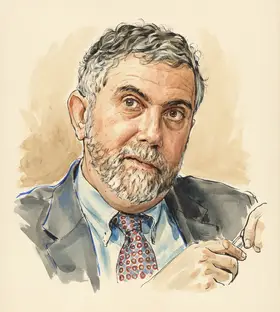
Paul Krugman on Economics
TL;DR
Paul Krugman strongly advocates for Keynesian macroeconomic principles, emphasizing fiscal stimulus and open-market theory.
Key Points
He received the 2008 Nobel Memorial Prize in Economic Sciences for his work on new trade theory and new economic geography.
He co-authored the standard undergraduate textbook on international economics, International Economics: Theory and Policy, with Maurice Obstfeld.
He has advocated for an aggressive use of fiscal stimulus to counter liquidity traps, referencing Japan's 'lost decade' in the 1990s.
Summary
Paul Krugman is an influential American economist, a Nobel laureate for his work on new trade theory and new economic geography. His core economic position is rooted in Keynesian principles, advocating for aggressive fiscal policy, especially to combat stagnation or liquidity traps, which he sees as necessary when conventional monetary policy is constrained. He has built upon his academic work, which modeled international trade based on economies of scale and consumer preference for diversity, to inform his public commentary on topics like trade, inequality, and financial crises. The Nobel Prize Committee cited his contributions explaining patterns of international trade and the geographic distribution of economic activity.
His analysis often evolves with current events, such as examining how global financial fragility or changes in oil market dynamics create new vulnerabilities. He has previously discussed the effects of hyper-globalization on inequality and has been a vocal proponent of policies like inflation targeting to escape economic slumps, drawing parallels between past crises and modern recessions. While generally supportive of free trade, he has acknowledged that economic models have sometimes underestimated the local employment impact of globalization, leading to a more nuanced public stance on trade agreements over time.
Key Quotes
The U.S. economy has tripled in size, but oil consumption now is about the same as it was in the late 1970s.
Frequently Asked Questions
Paul Krugman primarily identifies as a Keynesian economist, often referred to as a 'saltwater' economist in contrast to the 'freshwater' school. He champions the practical use of models like IS-LM and advocates for aggressive fiscal policy, especially during severe economic downturns.
While generally supportive of free trade and globalization, Krugman's academic work on New Trade Theory suggested that it should be considered a 'reasonable rule of thumb' rather than an always optimal policy. He has also acknowledged that models underestimated its impact on jobs and inequality in developed nations.
His most recognized academic contributions are in the fields of New Trade Theory and New Economic Geography, which analyze the effects of economies of scale and consumer preference for diverse goods on international trade and the location of economic activity.
Sources4
War, Oil and the World Economy
Paul Krugman - Wikipedia
Economics 7th Edition | Paul Krugman | Macmillan Learning
* This is not an exhaustive list of sources.