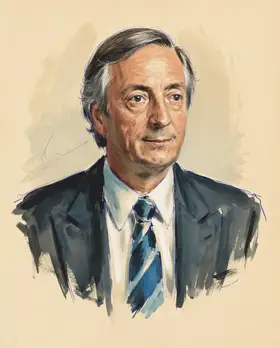
Néstor Kirchner on Military Coup
TL;DR
Néstor Kirchner vocally condemned Argentina's military coup, demanding justice and fighting impunity for the regime's crimes.
Key Points
In his March 24, 2004, speech, he formally asked the state's pardon for twenty years of silence regarding the dictatorship's atrocities.
He advocated for repealing the 'full stop' and 'due obedience' amnesty laws, which prevented full judicial proceedings against military officials.
His administration established March 24th as the permanent 'Day of Memory for Truth and Justice' in 2006.
Summary
Néstor Kirchner, as president, took a decisive stance against the 1976 military coup, marking its anniversary with public ceremonies that broke from past silence. His core position centered on rejecting the justification of state terrorism and demanding accountability for human rights violations committed during the dictatorship. Key evidence of this stance includes his actions to transform the ESMA torture center into a Museum of Memory in 2004 and his vocal support for annulling the amnesty laws that shielded many perpetrators. He framed the dictatorship's actions as a criminal plan and explicitly rejected the notion that the military acted justifiably to restore order.
The implications of his position were the official re-framing of the coup's legacy from a necessary response to chaos to an inexcusable atrocity. His administration established March 24th as the national Day of Memory for Truth and Justice, institutionalizing the process of confronting the past. By appealing to the idea of national unity, while simultaneously distinguishing the 'in-group' of victims and justice-seekers from the 'out-group' of coup perpetrators, Kirchner aimed to forge a new national narrative centered on memory and non-repetition.
Frequently Asked Questions
Néstor Kirchner's position was one of strong condemnation of the 1976 military coup, which he characterized as state terrorism, according to his public statements and actions as president. He explicitly rejected the notion that the coup was a necessary evil to restore order, instead framing it as a criminal plan against the Argentine people. His administration took concrete steps to confront this past, as detailed in his commemorative speeches.
Néstor Kirchner's presidency implemented several significant actions to confront the coup's legacy, including ordering the transformation of the ESMA Navy Mechanics School into a Museum of Memory, as documented in 2004. He also strongly supported the 2005 annulment of the amnesty laws, which was crucial for reopening trials against those involved in human rights violations. Furthermore, he cemented the public remembrance of the era by establishing the annual Day of Memory for Truth and Justice, as noted in academic analysis of his discourse.
Yes, Néstor Kirchner strongly believed the military leaders responsible for the dictatorship should face justice and fought against impunity, as he stated in a 2006 speech. He denounced the leaders of the junta, asserting they were 'assassins repudiated by the Argentine people.' His push to overturn the amnesty laws shows his commitment to ensuring that those responsible for the systematic human rights violations faced legal scrutiny.
Sources6
Former Argentinian death camp to become museum
Argentina Confronts Past on Coup Anniversary | Human Rights Watch
Pro and against Kirchner rallies on 29th anniversary of 1976 military coup — MercoPress
Collective Memory and the Argentine Military Dictatorship: A Discourse Analysis
30 Years Since Military Junta Celebrated
Argentine museum remembers victims of `Dirty War'
* This is not an exhaustive list of sources.