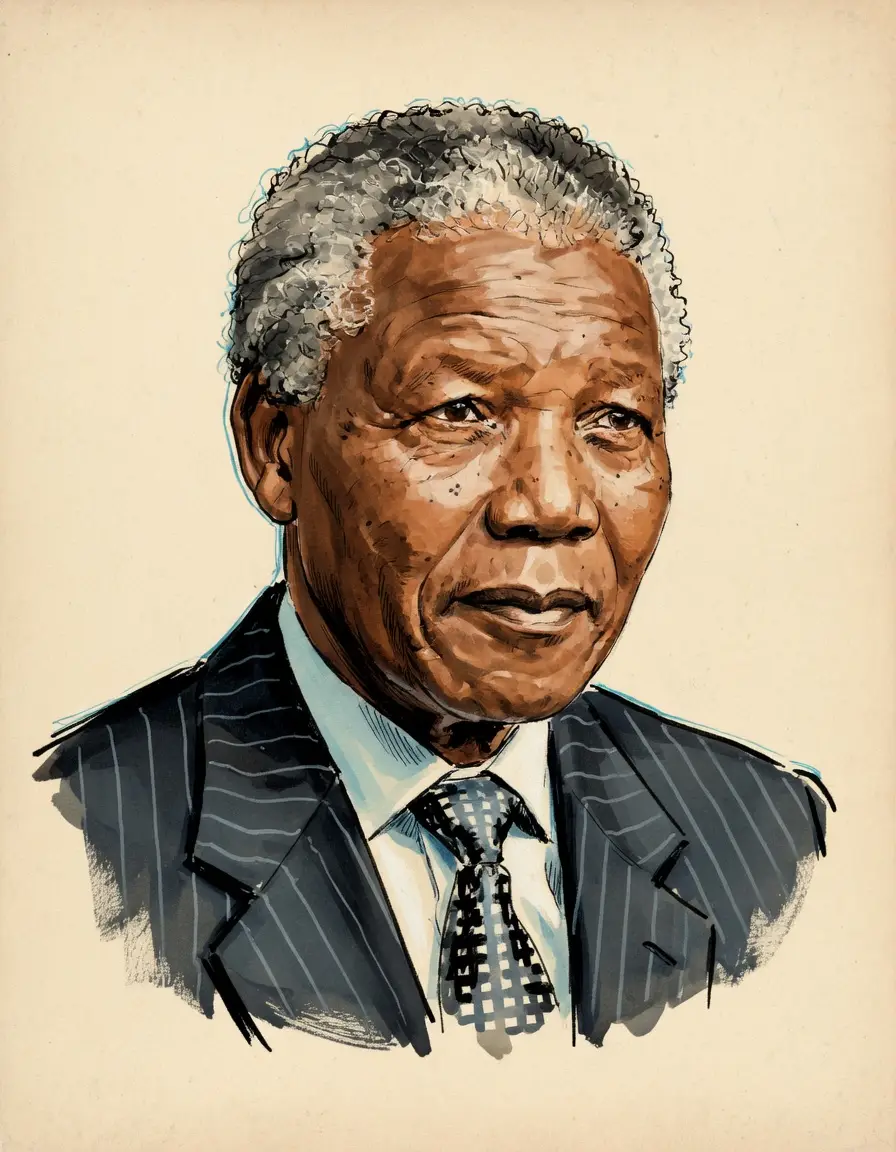
Nelson Mandela on Freedom
TL;DR
True freedom is indivisible and requires living responsibly to enhance the liberty of all others globally.
Key Points
He cherished the ideal of a democratic and free society where all persons live in harmony with equal opportunities, stating he would die for it (1964).
He believed freedom was indivisible, stating that the chains on any one person were chains on all, including himself.
As president, he stated in 1995 that with freedom comes the responsibility to accept in one's heart and mind the need for action against exclusion.
Summary
Nelson Mandela's core position on freedom was that it is an ideal for which he was prepared to die, embodying the pursuit of a democratic and free society where all persons coexist in harmony with equal opportunities. He contended that freedom was not achieved merely by breaking physical chains, but necessitated a broader commitment to live in a way that respects and enhances the freedom of everyone else. This meant fighting against all forms of domination, whether white or black, and working to eliminate systemic injustices like poverty, which he saw as an obstacle to true liberty.
The evolution of his stance reflected the difficult political realities he faced, moving from adherence to non-violent protest to accepting sabotage as a necessary defense when all peaceful channels were closed. Post-presidency, his emphasis shifted toward the responsibility accompanying emancipation, urging society to critically examine persistent exclusions and inequality, asserting that freedom could never be considered complete until the basic needs of all South Africans were met. His legacy connects personal liberty with collective responsibility and universal human dignity, extending beyond national borders to global liberation.
Key Quotes
“For to be free is not merely to cast off one's chains, but to live in a way that respects and enhances the freedom of others.”
“I have fought against white domination, and I have fought against black domination. I have cherished the ideal of a democratic and free society in which all persons live together in harmony and with equal opportunities. It is an ideal which I hope to live for and to achieve. But if needs be, it is an ideal for which I am prepared to die.”
Frequently Asked Questions
Nelson Mandela defined freedom as extending beyond the mere casting off of physical chains. For him, true freedom required living in a manner that actively respects and enhances the freedom of others in society. This included achieving political equality and ending racial domination.
No, Nelson Mandela viewed freedom as indivisible and interconnected globally, stating that their freedom could not be complete while others in the world remained unfree. His fight was against oppression everywhere, making his vision a universal one.
Upon achieving formal liberation, Nelson Mandela stressed that freedom is accompanied by a profound responsibility. He urged citizens to accept this responsibility, particularly in addressing enduring issues like poverty and systemic exclusion, to ensure dignity for all.
Sources9
The responsibility that comes with freedom
Nelson Mandela's Life & Statements Speaking Out For Justice
Remembering Nelson Mandela and His Vision of Freedom
Quotes by Nelson Mandela (Author of Long Walk to Freedom)
Let FREEDOM reign! Understanding freedom through 10 Nelson Mandela quotes
Nelson Mandela (April 20, 1964): I have cherished the ideal of a democratic and free society.... It is an ideal which I hope to live for and to achieve. But if needs be, it is an ideal for which I am prepared to die.
In the words of Nelson Mandela, “To be free is not merely to cast off one's chains”
Peace, poverty and race: here are some of Nelson Mandela's wisest words
Nelson Mandela: A Long Walk to Freedom
* This is not an exhaustive list of sources.