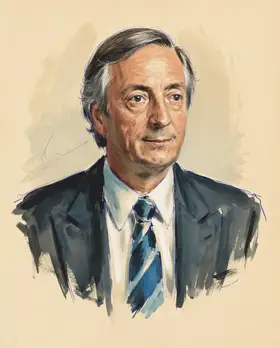
Néstor Kirchner on Political Ideology
TL;DR
Néstor Kirchner defined his political ideology as Peronism, blending it with a progressive framework known as Kirchnerism.
Key Points
He self-identified as a member of the Justicialist Party, following the tenets of Peronism.
His governing approach, Kirchnerism, incorporated progressive elements alongside traditional Peronist social policies.
The ideology favored a reassertion of the state's role in the economy and prioritized human rights accountability.
Summary
Néstor Kirchner explicitly identified his political ideology as Peronist, a movement that has historically encompassed a broad spectrum of political positions within Argentina. He further characterized his approach as progressive, which served as the foundation for what became known as Kirchnerism. This political current was marked by a reassertion of state power in the economy, a focus on human rights accountability following the last military dictatorship, and an emphasis on social justice and reindustrialization after the 2001 economic collapse. His initial governing strategy focused on reversing the neoliberal policies that preceded his presidency, marking a distinct ideological shift in the country's governance.
Kirchnerism evolved beyond a simple label, functioning as a distinct faction within the broader Justicialist Party, often generating internal tension with more centrist or conservative elements. His political vision involved strengthening national sovereignty, expanding social programs, and promoting a state role in strategic economic sectors. This blend of traditional Peronist support for workers and social welfare, coupled with a modern, left-leaning stance on social issues and state intervention, solidified his position as a significant ideological force in contemporary Argentine politics, even after his time in the presidency.
Frequently Asked Questions
Néstor Kirchner described his political ideology primarily as Peronist, positioning himself within the framework of the Justicialist Party. He further articulated his specific approach by blending this identity with progressive tenets, which subsequently became known as Kirchnerism, according to historical analyses. This dual identification shaped his governance style throughout his presidency.
The ideology of Néstor Kirchner was characterized by a strong emphasis on state intervention in the economy and a commitment to social justice, as noted by various political commentators. His political program also strongly featured the continuation of proceedings against human rights abusers from the last military dictatorship. This positioned his political outlook distinctly against the prior neoliberal consensus in Argentina.
Néstor Kirchner maintained a consistent identification as a Peronist throughout his key political roles, from Governor to President. While his specific policy implementations shifted to address post-crisis needs after 2001, the foundational ideological markers of Peronism and progressivism remained constant in his public statements. This consistency is reflected in the enduring nature of the term Kirchnerism itself.
Sources8
Argentine president's secret weapon: A super-charged youth movement
From Crisis to Controversy: The Kirchners' Impact on Argentina
As Latin America revolts in Argentina, the insurrection was at the ballot box
Néstor Kirchner, the architect of modern Argentina
Kirchnerism
A State of Contradictions: Argentine Democracy and Its Illiberal Threats
Argentina's Peronism: A Case of Electoral Continuity and Ideological Change
Electoral Competition and the Organization of Argentine Political Parties
* This is not an exhaustive list of sources.