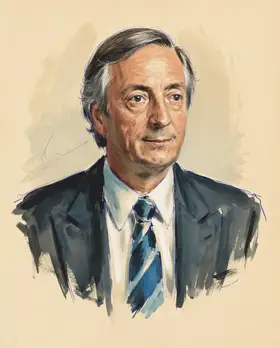
Néstor Kirchner on Junta Trials
TL;DR
Néstor Kirchner strongly supported the resumption and advancement of trials for crimes committed during the dictatorship.
Key Points
He overturned a decree in 2003 that had been denying cooperation with foreign extradition requests for dictatorship-era crimes.
His administration established the Archivo Nacional de la Memoria (National Archive of Remembrance) in December 2003 to manage and conserve documents on human rights violations.
In 2004, Néstor Kirchner ordered the removal of the portraits of former junta leaders from the Army's training college as an official government act.
Summary
Néstor Kirchner's presidency marked a paradigm shift toward explicitly prioritizing coming to terms with the past, making it a central policy goal. His administration provided active institutional support to judicial investigations, which had been stalled for years due to prior amnesty laws and presidential pardons. A key action demonstrating his commitment was the 2003 decree that overturned the previous government's measure which had prohibited cooperation with foreign extradition requests related to dictatorship-era crimes. This demonstrated a willingness to support judicial proceedings both domestically and abroad. Furthermore, under Kirchner's tenure, Parliament passed legislation in 2003 annulling the controversial 'Full Stop' and 'Due Obedience' amnesty laws, which ultimately enabled the full reopening of human rights trials after the Supreme Court declared them unconstitutional in 2005.
This renewed push for accountability was framed strategically by the Kirchner government, aligning with the demands of human rights organizations that had long fought impunity. The government strengthened the Secretariat for Human Rights and took symbolic steps, such as making the anniversary of the 1976 coup a national holiday in 2006. The president personally engaged in highly symbolic acts, such as removing the portraits of former junta generals from the Army's training college in March 2004. This governmental embrace of the victims' agenda, supported by a more stable economic and political context than his predecessors enjoyed, created the political momentum necessary for the large-scale human rights trials to progress significantly throughout his term.
Frequently Asked Questions
Néstor Kirchner made coming to terms with the past an explicit policy goal of his presidency, directly opposing the previous era of impunity. According to reports on transitional justice, he provided active institutional support to the judicial investigations that sought to prosecute past crimes. His administration created the National Archive of Remembrance and worked to advance the judicial process against former regime members.
Yes, Néstor Kirchner's election in 2003 was seen as 'good news for the human rights movement in Argentina' because he strongly promoted the continuation of trials. He successfully pushed for the annulment of the amnesty laws that had previously shielded military officers from prosecution. This created the legal path for the human rights trials to resume in the 2000s.
In March 2004, President Néstor Kirchner ordered the official removal of the portraits of the junta generals, including Videla and Bignone, from the Army's training college. This highly symbolic act was seen as a clear demonstration of the military's subordination to civilian government authority.
Sources8
After Dictatorship - Nach der Diktatur: After Dictatorship Page 1 After Dictatorship Instruments of Transitional Justice in Post-Authoritarian Systems
Argentina pauses to reflect and remember victims of military dictatorship | Buenos Aires Times
Trial of the Juntas - Wikipedia
Memory and Truth in Human Rights: The Argentina Case. The Issue of Truth and Memory in the Aftermath of Gross Human Rights Violations in Argentina.
Voice from Thailand Calling for the Convention Now - disappearED Asia
Performing Future Affiliations in Argentine Spaces of Memory – mezosfera.org
The Pendulum of Justice: Political Dynamics Shaping Prosecutions in Argentina 1983-2025
Introduction - International Center for Transitional Justice (ICTJ): Introduction
* This is not an exhaustive list of sources.