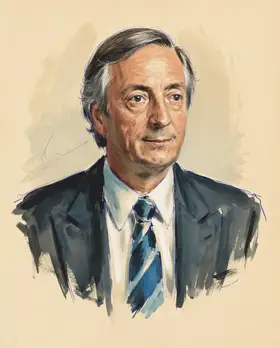
Néstor Kirchner on Cristina Fernández de Kirchner
TL;DR
Néstor Kirchner viewed Cristina Fernández de Kirchner as his political successor, transferring the presidency to her in 2007.
Key Points
Néstor Kirchner stepped aside in 2007, enabling his wife, Cristina Fernández de Kirchner, to run for and win the presidency.
He served as First Gentleman of Argentina from December 10, 2007, until his death on October 27, 2010.
Both Néstor and Cristina Kirchner are alleged by prosecutors to have organized an illicit fundraising system between 2003 and 2015.
Summary
Néstor Kirchner viewed his wife, Cristina Fernández de Kirchner, as his political successor, stepping aside in 2007 so she could run for the presidency, which she won. Observers at the time of his death agreed that he had been the main source of political support for her administration, acting as a "shock absorber on many issues," particularly economic topics, and some even suggested he functioned as her real Minister of Economics. He had placed her as a candidate for the Senate in 2005, a contest she won, which reinforced her political standing and insulated her against charges of inexperience during her own subsequent run for the presidency.
His death in October 2010 created significant uncertainty regarding how her administration would function without his backing, with some experts drawing parallels to the difficult succession after Juan Perón's death, posing a question of whether she would become a strong leader or an ineffective one. In terms of political structure, he supported her presidential bid, and while in office, they together dominated the political scene, leading the 'Kirchnerism' movement. The prosecution in a later corruption trial alleged that both organized a fundraising system to illicitly enrich themselves between 2003 and 2015.
Frequently Asked Questions
Néstor Kirchner actively supported his wife, Cristina Fernández de Kirchner, by stepping aside in 2007 to allow her to run for president, positioning her as his direct successor. Observers believed that during her term, he remained highly influential, often supervising economic matters and leading the Justicialist Party. This dynamic was frequently compared to other political couples in history.
Yes, Néstor Kirchner provided strong political support to Cristina Fernández de Kirchner throughout their shared political careers, culminating in his decision not to seek reelection in 2007. According to experts following his death, he was seen as a key political stabilizer for her government.
Néstor Kirchner's sudden death in October 2010 created a high degree of uncertainty for Cristina Fernández de Kirchner's administration, as he was considered a major source of support. However, the resulting sympathy led to a surge in her popularity, which helped her secure a landslide victory for a second term in 2011.
Sources7
Cristina Fernández de Kirchner Faces a New Challenge: Leading Argentina on Her Own
Cristina Fernandez de Kirchner | Archives of Women's Political Communication
Argentine court orders seizure of $500M in assets linked to former President Cristina Fernández de Kirchner - Argentina Reports
Néstor Kirchner - Wikipedia
For Cristina Kirchner, the day that would never come has arrived | Latinoamérica 21
Argentina's top court upholds Fernandez de Kirchner's prison sentence | News | Al Jazeera
Cristina Kirchner and 86 other defendants face the biggest corruption trial in Argentina's history | International | EL PAÍS English
* This is not an exhaustive list of sources.