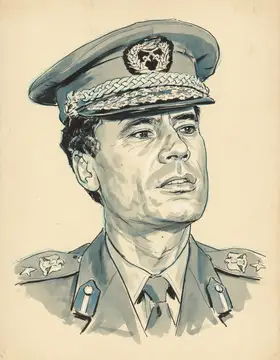
Muammar Gaddafi on Islam
TL;DR
Muammar Gaddafi promoted an idiosyncratic Islamic modernism centered on the Quran, rejecting the Hadith and traditional clerical authority.
Key Points
He called for an Islamic revival that returned to the origins of the Qur'an, rejecting scholarly interpretations and the Hadith starting in 1973.
He decreed that Islamic law should be the basis for the legal system of the state, blurring religious and secular realms, though later backed away from applying all sharia due to property rights conflicts with his socialism.
In 2010, he publicly encouraged Italian women to convert to Islam during a lecture event organized through a hostess agency in Rome.
Summary
Muammar Gaddafi viewed Islam as inseparable from Arab nationalism, promoting an ideology he termed "Islamic socialism" which sought an Islamic revival based strictly on the Qur'an, leading him to reject the Hadith as unreliable or fabricated. He considered man-made laws unnatural, insisting that Islamic law, as he interpreted it, should form the basis of the state's legal system, which in 1972 involved introducing flogging as punishment for adultery and homosexual activity. This interpretation put him at odds with conservative Libyan clerics who opposed his perceived secularizing reforms, such as his encouragement of women entering traditionally male sectors like the armed forces.
His position on Islam evolved throughout his rule, shifting from a strict application of sharia to later questioning its application after he embraced his Third International Theory and socialism, which contradicted the Islamic protection of private property. In the 21st century, while still promoting Islam, his focus shifted significantly toward pan-Africanism, though he continued to suppress domestic Islamist opposition groups. Furthermore, his public efforts, like lecturing Italian women in Rome about converting to Islam, demonstrated his active desire to propagate his vision of the faith internationally, sometimes in unconventional ways.
Frequently Asked Questions
Muammar Gaddafi maintained a positive view of Islam, integrating it into his political ideology as an Islamic modernist, according to biographical accounts. He saw Arabism and Islam as inseparable, but his personal interpretation was idiosyncratic, favoring the Quran over Hadith collections, as noted in various historical documents. He actively sought to propagate his version of the faith internationally while ruling Libya.
Yes, Muammar Gaddafi's emphasis within his Islamic views appeared to evolve alongside his broader political theory, as historical sources suggest. While he initially insisted on sharia law as the basis for the legal system, he later appeared to backtrack on aspects like property rights because they conflicted with his socialist principles outlined in The Green Book. His primary international focus also shifted from pan-Arabism to pan-Africanism in the early 2000s.
Muammar Gaddafi openly clashed with conservative Libyan clerics due to his theological positions and social policies, as reported by historical analysts. His emphasis on his own work, The Green Book, being on par with the Quran led some clerics to accuse him of shirk. He viewed his role as being driven by a sense of divine mission to achieve his political goals, sometimes overriding clerical objections.
Sources9
Muammar Gaddafi on Hadith Rejection : r/progressive_islam
Gaddafi says only Islam a universal religion
Muammar Gaddafi 2006: "We have 50 million Muslims in ...
Muammar Gaddafi
Gaddafi calls on Europe to convert to Islam on trip to Rome
Gaddafi lures ladies to Islam talk | News
Gaddafi hires 200 young Italian women – to convert them ...
Being Able to Prosecute Saif al-Islam Gaddafi
* This is not an exhaustive list of sources.