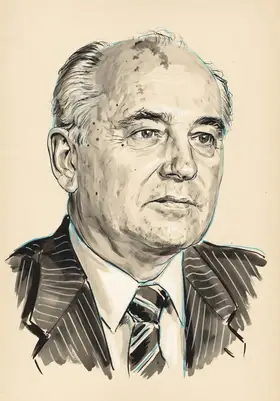
Mikhail Gorbachev on Role in the World
TL;DR
Mikhail Gorbachev believed the post-Cold War world required new thinking, morality, and robust international governance through cooperation.
Key Points
He proposed that modern leaders needed intellectual and moral authority to persuade rather than compel, especially due to the shadow of nuclear weapons.
Gorbachev called for a new agenda where the most important global issues—nuclear weapons, poverty, and the ecological crisis—would be addressed collectively, as none could be solved militarily.
He believed Russia's role in overcoming the global political crisis could and must be important and positive, urging the West to renounce attempts to isolate Russia.
Summary
Mikhail Gorbachev contended that the end of the Cold War presented the world with an opportunity for a truly new order, but lamented that these possibilities were often squandered by triumphalism and a failure to grasp the realities of a globalized era. He strongly criticized leaders who refused to build a new, equitable security system, arguing that this leadership crisis led to global troubles, including militarization and growing wealth gaps. He emphasized that the most significant global problems—such as weapons of mass destruction, poverty, and terrorism—could not be solved by military means alone, necessitating unity and a focus on a renewed agenda centered on universal human values.
His position stressed the critical importance of uniting politics with morality, warning against the danger of "double standards" in international relations. Gorbachev advocated for establishing specific rules of conduct based on human morality to regulate relations between governments, suggesting that adherence to such ethical codes could have averted conflicts like those in Syria and Ukraine. He viewed international organizations like the UN as crucial mechanisms for conflict resolution and prevention that had been weakened by unilateralism and the failure to adopt this 'new thinking' after 1991.
Key Quotes
Today, the preservation of any kind of 'closed' society is hardly possible
Frequently Asked Questions
Mikhail Gorbachev believed the United States, as the sole superpower after the Cold War, had a unique responsibility to help shape an international order based on universal values. He warned against the triumphalism and unilateralism that followed the Soviet collapse, which he felt undermined the UN and global stability.
He strongly advocated for a shift from an economy of armaments to an economy of disarmament, building on the principle that nuclear war must never be fought. Gorbachev pushed for mutual security and the replacement of hostile blocs with a common international system based on trust.
No, he believed the West had an erroneous interpretation of the Cold War's end, marked by a 'winner's complex' and a claim to monopoly leadership. This led to the abandonment of opportunities for a new, equitable world order and the weakening of international mechanisms like the UN.
Sources6
Mikhail Gorbachev: The world again needs new thinking
At a crossroads: The anxieties of a globalized world
ESSAYS ON LEADERSHIP: ON NONVIOLENT LEADERSHIP Mikhail Gorbachev
Message from Mikhail Gorbachev to 1991 G7 Summit Leaders
The Gorbachev Challenge | TIME
October Man: Mikhail Gorbachev | Hoover Institution
* This is not an exhaustive list of sources.