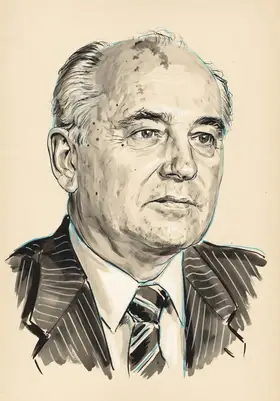
Mikhail Gorbachev on India
TL;DR
Mikhail Gorbachev considered India an exemplary and crucial strategic partner, especially concerning disarmament and countering US global influence.
Key Points
He visited India twice during his tenure, first in November 1986 and again in November 1988.
His 1986 visit resulted in the signing of the 'Delhi Declaration' with Rajiv Gandhi, advocating for a nuclear-weapon-free world.
During his leadership, India received T-72 tanks and was the first 'Third World' country to lease a nuclear submarine from the USSR.
Summary
Mikhail Gorbachev viewed India as an exemplary bilateral partner, continuing and deepening the relationship established by his predecessors during the Cold War era. His tenure, marked by 'new thinking,' saw him foster a strong personal rapport with Prime Minister Rajiv Gandhi, viewing New Delhi as a vital partner for global initiatives like nuclear disarmament. This cooperation was formalized by the 'Delhi Declaration' in 1986, which called for a nuclear-weapon-free world and non-violence, echoing concepts important to India. He also found common ground with Gandhi in opposing the militarization of the Indian Ocean and the US Strategic Defense Initiative.
Despite the positive momentum, Gorbachev's evolving foreign policy presented nuances for India. A core Soviet goal under his leadership was normalizing relations with China, a shift that made India nervous, as Moscow became conspicuously silent during border crises between New Delhi and Beijing. Furthermore, while India remained a prime recipient of advanced Soviet military technology, including T-72 tanks and a nuclear submarine lease, the Soviet focus increasingly centered on reducing global Cold War tensions with the United States rather than solely on regional South Asian dynamics. By the late 1980s, India was no longer the Soviet Union's sole or leading priority in Asia.
Frequently Asked Questions
Mikhail Gorbachev generally held a very positive view of the relationship, describing it as 'exemplary' at one point. He considered India an important strategic partner, continuing a strong bond forged in the Cold War era. He actively sought to maintain and strengthen these ties with his Indian counterpart, Rajiv Gandhi.
Yes, Gorbachev's overall 'new thinking' in foreign policy, which prioritized thawing relations with the US and normalizing ties with China, influenced his focus on India. While India remained important, the Soviet push for Sino-Soviet detente made New Delhi nervous, as Moscow was less willing to unequivocally back India against China.
The key document signed was the 'Delhi Declaration' during his first visit in November 1986 with Prime Minister Rajiv Gandhi. This declaration called for a nuclear weapon-free world and non-violence, aligning with shared global disarmament concerns.
Sources5
'When friends call, our hearts light up': Amid Cold War, Mikhail Gorbachev's historic visits to India
List of international trips made by Mikhail Gorbachev - Wikipedia
The Main Drivers of Soviet Foreign Policy Towards India, 1955–1991
Gorbachev was 'most trusting' of Rajiv Gandhi, gave T-72 tanks to India before some close allies
Memorandum of Conversation between Mikhail Gorbachev and Rajiv Gandh, July 2, 1987.
* This is not an exhaustive list of sources.