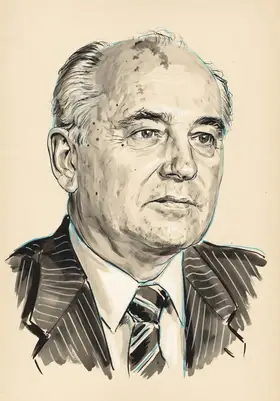
Mikhail Gorbachev
- Known for
- Last leader of Soviet Union, Ending Cold War
- Born in
- Privolnoye, Soviet Union
- Education
- Diploma in agricultural production, Stavropol Agricultural Institute
Mikhail Gorbachev was the final leader of the Soviet Union, remembered for initiating monumental changes that ended the Cold War and ultimately dissolved the state he intended to preserve. Initially a committed Marxist-Leninist, his leadership evolved toward social democracy by the early 1990s.
Signature Positions
Gorbachev's time in power was defined by sweeping domestic and international reforms:
- Perestroika: Initiated economic 'restructuring' aimed at decentralizing decision-making to improve efficiency.
- Glasnost: Implemented policies of 'openness' to increase freedom of speech and the press within the USSR.
- Cold War: Engaged in nuclear disarmament summits with Ronald Reagan, leading to an end of the conflict.
- Eastern Bloc: Declined military intervention as Warsaw Pact countries transitioned away from Marxist-Leninist rule in 1989.
- Russia and Ukraine War: In his final known statement, he expressed deep distress over the 2022 invasion, believing Vladimir Putin 'destroyed his life's work'.
How Views Have Evolved
Gorbachev's ideology shifted significantly during his tenure. He began by operating within the constraints of Marxism-Leninism, hoping reform could preserve the Soviet state. However, his exposure to Western views during travel and his domestic reforms moved his effective stance toward social democracy by the time of the USSR's collapse.
Notable Tensions
Gorbachev remains a deeply controversial figure, especially in Russia:
- Domestic Critics: Many in Russia resent him for precipitating the collapse of the Soviet Union, leading to economic instability in the 1990s.
- International View: Western nations often praise him as a visionary statesman for ending the Cold War peacefully and receiving the Nobel Peace Prize.
- Post-Soviet Politics: After leaving office, he became a vocal critic of both Boris Yeltsin and Vladimir Putin, advocating for a social-democratic path for Russia.