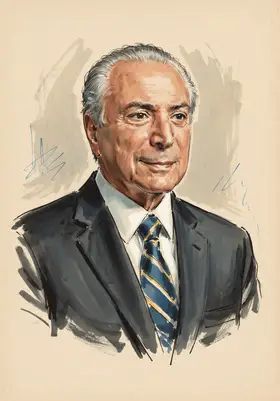
Michel Temer on Employment Rights
TL;DR
Michel Temer's administration championed a major labor reform that significantly weakened trade union power and increased job flexibility.
Key Points
The 2017 Labour Reform, approved under his government, prioritized direct negotiation between employers and employees over existing labor legislation.
The reform included measures such as allowing companies to outsource core business-related activities, which was previously illegal.
The actions taken during his administration were described by trade union centers as an 'aggressive attack on social rights' that made work more precarious.
Summary
Michel Temer, as president, aggressively pursued neoliberal policies that substantially reformed Brazilian labor law, aiming to revitalize the economy through increased flexibility and reduced costs for employers. This effort culminated in the 2017 Labour Reform, which dramatically altered over a hundred clauses in existing labor laws, fundamentally reshaping the relationship between employers and employees. Key changes included allowing collective bargaining agreements to override certain statutory rights, eliminating the mandatory union involvement in negotiating overtime for individuals, and no longer requiring union ratification for employee terminations.
These reforms, characterized by critics as a severe weakening of worker protections, also introduced new contract types, increased the ease with which employers could hire and fire, and diminished the power of labor courts and inspectors. The context for these changes was an economic downturn and a desire to restore orthodox neoliberalism after the previous administration. This legislative action was widely criticized by trade unions for increasing the precarity of work and undermining the collective bargaining strength of the labor movement in Brazil.
Frequently Asked Questions
Michel Temer's main impact was the passing of the extensive Labour Reform in 2017. This legislation significantly increased flexibility for employers by loosening regulations on contracts, overtime, and union involvement in dismissals. Critics argue this was a move towards weakening established worker protections.
No, the reforms were reportedly drafted directly by lobbyists working for employers' associations and were implemented without discussion with trade unions or labor councils. This lack of consultation was a major point of contention for organized labor.
The reforms severely weakened the trade union movement by making union fees optional instead of mandatory, which caused a sharp decline in union funding. It also reduced the role of unions in collective bargaining and the ratification of employment terminations.
Sources9
Brazil - Employer Update 2017
Brazil's trade union centres take action against Temer ... - IndustriALL
Labor laws in Brazil liberalized to permit outsourcing of jobs
Brazil
Brazil's Political Rupture and the Left's Opportunity
The Challenge to Democracy in Brazil
The Challenge to Democracy in Brazil
Precarious work and mechanisms of control across the ...
Human Rights Reports: Custom Report Excerpts
* This is not an exhaustive list of sources.