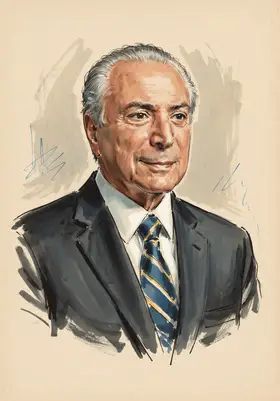
Michel Temer on Dilma Rousseff Impeachment
TL;DR
Michel Temer initially supported the process that led to Dilma Rousseff's impeachment, but later claimed he did not actively support the coup.
Key Points
He succeeded Dilma Rousseff as the 37th President of Brazil on August 31, 2016, after the Senate convicted her.
Temer was accused of treachery by Rousseff, who claimed he was part of an open conspiracy against her government.
In 2019, Temer admitted that Rousseff was removed for refusing to implement his "Ponte para o futuro" neoliberal policy platform.
Summary
Michel Temer assumed the presidency following the suspension and subsequent impeachment of Dilma Rousseff, a process he was deeply involved in as her Vice President. Initially, he maintained a public stance suggesting Rousseff was removed due to her refusal to implement his preferred ultra-neoliberal economic agenda, framing the ouster as a necessary political shift for economic recovery. Despite his direct involvement in actions leading up to the trial, including leaking a recording where he spoke as the incoming president, Temer later stated he never actively committed to or supported a 'Coup.'
Although Temer benefited directly by taking office, he claimed he did not imagine becoming President through those means and that her impeachment would not have occurred had former President Lula da Silva joined her cabinet. His succession marked a dramatic political break, with Temer promising a government of "national salvation" focused on fiscal austerity, while Rousseff and her allies consistently denounced the entire proceeding as an illegitimate coup against the elected leader.
Key Quotes
“It is urgent we calm the nation and unite Brazil,”
Frequently Asked Questions
Michel Temer was Dilma Rousseff's Vice President and assumed the presidency after the Senate voted to suspend her in May 2016. His involvement was controversial, highlighted by a leaked audio file where he spoke as if the impeachment had already concluded with him as the new president. He inherited the remainder of her term.
Temer directly benefited from the impeachment, taking office as president upon Rousseff's removal. While he later claimed he did not actively support a 'Coup,' his actions, like sending a letter complaining about his distance from government decisions, suggested opposition to her administration. He ultimately stated she was impeached for rejecting his economic agenda.
After leaving office, Michel Temer referred to Dilma Rousseff's impeachment twice as a 'Golpe' (Coup) during a 2019 television interview. He insisted that he never supported or made a commitment to the coup, though he conceded that the removal was to implement his neoliberal platform.
Sources8
Brazil's President Michel Temer says Rousseff was impeached for refusing his economic agenda
Brazil After Dilma: Temer's Turn | Baker Institute
Michel Temer: "It was a Coup" - BRASILWIRE
'Trust me': Michel Temer takes over as interim Brazil president
Brazil: Current president is a traitor, says Rousseff | Dilma Roussef News | Al Jazeera
Impeachment Should Be Legitimized By An Election In Brazil
Michel Temer - Wikipedia
After Dilma Rousseff ousted, new Brazilian president Michel Temer urges nation to unite behind him | CBC News
* This is not an exhaustive list of sources.