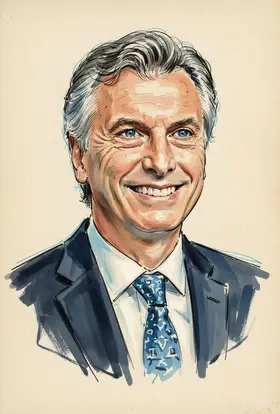
Mauricio Macri on Néstor Kirchner
TL;DR
Mauricio Macri positioned himself as the antithesis to the Kirchners' economic and governance model.
Key Points
Macri blamed the decade of Kirchner rule for the spread of drug trafficking in Argentina up to his election in 2015.
His post-election actions included intentions to break with leftist foreign policies of the Kirchner era, such as pushing to suspend Venezuela from Mercosur.
Macri's incoming government's agenda was explicitly framed as a reversal of the Kirchner/Fernández years' economic model of state intervention and deficits.
Summary
Mauricio Macri built his political rise, culminating in his 2015 election, largely upon a platform fundamentally opposed to the legacy of Néstor Kirchner and his successor. He consistently framed the prior twelve years of Kirchnerist rule as one of economic mismanagement, characterized by rising debt, increased state intervention, and corruption allegations regarding public funds and official wealth accumulation. Macri's administration sought a sharp break, promising to normalize the economy, lift currency controls, and seek international investment, directly challenging the economic structure left in place by the Kirchners.
This opposition extended beyond economics, as Macri also blamed the Kirchner period for institutional weakness and a surge in drug trafficking, which he vowed to combat with increased security measures. His administration's political goal was to reverse the trajectory set by the previous government, with one analyst noting that Macri’s presidency was viewed as a potential parenthesis between the successive Kirchner terms. The narrative employed by Macri against the Kirchners was highly polarizing, framing his administration as the necessary choice to prevent further national decline.
Frequently Asked Questions
Mauricio Macri viewed the legacy of Néstor Kirchner, and the subsequent Kirchner era, in a strongly negative light. He based much of his 2015 presidential campaign on offering a fundamental political and economic alternative to the preceding twelve years of Kirchnerism.
Yes, Macri strongly challenged the economic policies, which he associated with Néstor Kirchner, blaming them for stagnation and high state intervention. His administration sought to implement market-oriented reforms like ending currency controls to spur growth.
Macri's political strategy was largely defined by anti-Kirchnerism, which allowed him to consolidate support from moderate Peronists and anti-populist sectors. His victory in 2015 effectively ended the Kirchners' twelve-year hegemony over the national government.
Sources6
The Kirchner legacy: Will Macri be able to prevent the 'Mexicanization' of Argentina?
Argentina President Mauricio Macri Sworn In, Snubbed by Kirchner
Argentina: Back to Normal
Mauricio Macri Takes Helm in Argentina: Tough Battle with Vulture Politicians Ahead
Macri's Yellow Balloons - Jacobin
A Banner Night and a Brighter Future for Argentina's President Macri
* This is not an exhaustive list of sources.