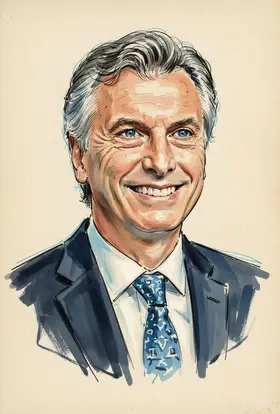
Mauricio Macri on Government Policies
TL;DR
Mauricio Macri advocated for pro-business neoliberal policies centered on austerity, fiscal discipline, and attracting foreign investment.
Key Points
Eliminated agricultural export taxes, primarily on soy, shortly after taking office on December 10, 2015.
Implemented significant increases in public service tariffs, such as for electricity and gas, in 2016-2017.
Issued a decree in July 2018 allowing the armed forces to intervene in domestic security matters, citing national security.
His administration pursued a major $56 billion loan agreement with the International Monetary Fund (IMF).
Summary
Mauricio Macri implemented a government agenda focused on reconfiguring the Argentine economy along explicitly neoliberal lines, aiming to boost the country by attracting foreign investment and reducing state spending. His administration quickly dismantled many progressive economic and social policies from the previous Kirchner governments, often using emergency decrees to bypass Congress. Key initial measures included eliminating agricultural export taxes, which had funded social programs, and lifting currency controls, which immediately devalued the peso. This shift was supported by domestic capitalists and international corporations but led to public outcry from social movements and the working class due to austerity measures.
The resulting economic model involved increasing dependence on foreign creditors, including renewing ties with the International Monetary Fund and settling with hold-out creditors. The government committed to reducing public spending and removing subsidies for utilities, though it maintained much of the previous administration's social spending initially. This approach aimed for slow, steady adjustment, or "gradualism," rather than shock treatment, but it faced severe challenges, including rising inflation, economic contraction, and increasing poverty rates during his term.
Frequently Asked Questions
Mauricio Macri's core approach was fundamentally pro-business and neoliberal, aiming to reverse the previous administration's policies. He prioritized fiscal caution, reducing state spending, and liberalizing markets to attract foreign investment and achieve long-term economic growth.
Mauricio Macri sought to reduce state spending and remove subsidies that kept utility prices artificially low. While his team maintained much of the social spending from the previous government initially, the overall fiscal adjustment led to cuts and increased economic precarity for many Argentines.
No, the declared objectives of reducing inflation and poverty were not achieved during his term. Inflation increased significantly, and poverty rates rose substantially between 2015 and the end of his presidency.
Sources9
Assessing the Macri Legacy
The Changing Tide in Argentina: An Assault on the Public Sector and a Shift Towards Austerity
Seeds of discontent: Argentina's farmers turn cool on their man Macri
Argentina's New Order
Macri's Argentina: Is This Time Different?
Despite 'zero poverty' promise in Argentina, poverty is on the rise
Argentina: A Call for National Unity in the Face of High Political and Economic Uncertainty
Repression Intensifies in Argentina After President Empowers Military
Addressing Poverty in Argentina: President Macri's "Zero Poverty Promise"
* This is not an exhaustive list of sources.