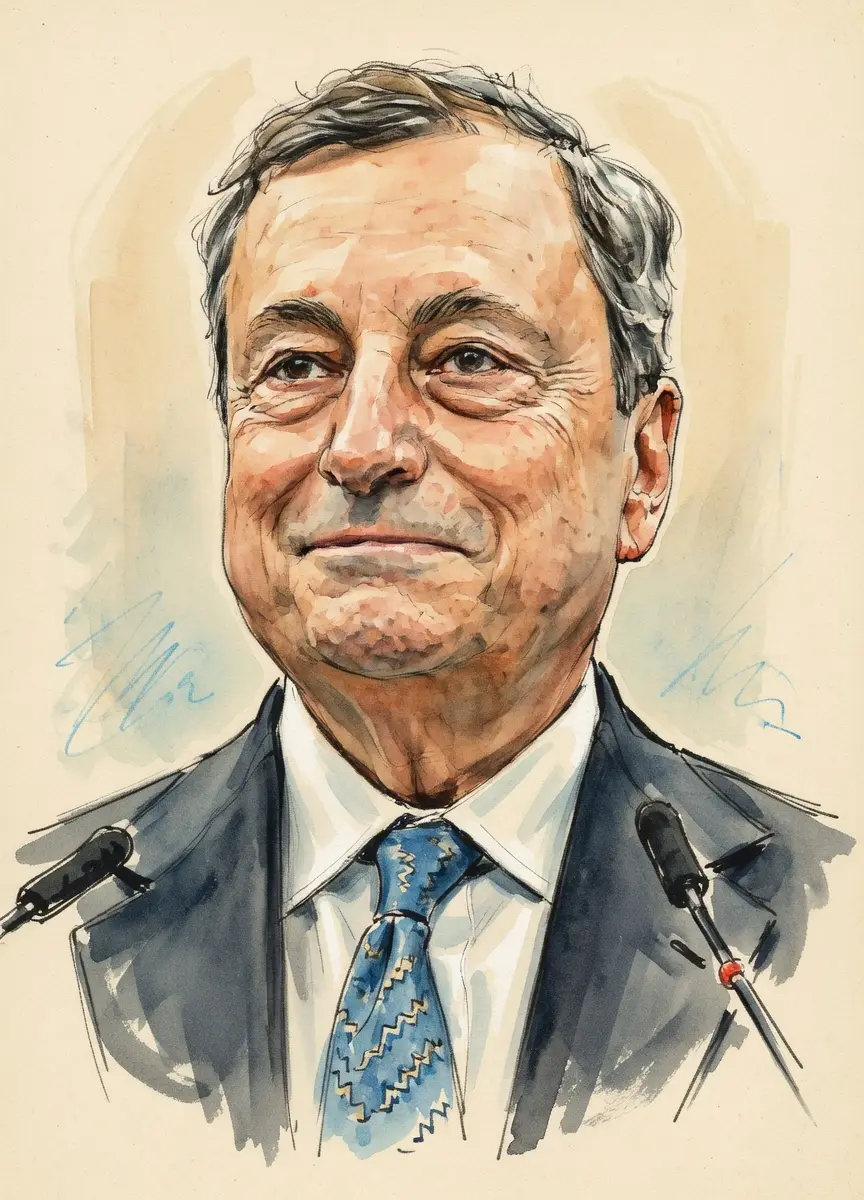
Mario Draghi on European Central Bank
TL;DR
Mario Draghi's tenure at the European Central Bank was defined by decisively preserving the euro during the sovereign debt crisis.
Key Points
As ECB President, he declared in July 2012 the readiness to do "whatever it takes to preserve the euro."
Macro-economic indicators such as unemployment and yield spreads improved significantly during his tenure from 2011 to 2019.
His parting actions in September 2019 included restarting quantitative easing and cutting the deposit facility rate to –0.5 per cent.
Summary
Mario Draghi's position regarding the European Central Bank (ECB) centers on his legacy as its president from 2011 to 2019, a period marked by existential threats to the Eurozone. He played a decisive role in turning the tide during the Greek sovereign debt crisis, famously declaring in July 2012 that the ECB was ready to do "whatever it takes to preserve the euro." This action is widely credited with averting the collapse of the single currency and restoring confidence across financial markets, leading to improved macroeconomic indicators like lower unemployment and shrinking yield spreads among member states.
Despite the successful defense of the euro, his use of unconventional policies, such as asset purchase programmes and cutting the deposit facility rate into negative territory, generated sustained controversy. Critics argued these measures exceeded the ECB's mandate and risked asset-price bubbles while undershooting the price stability target, which remained a major challenge upon his departure in 2019. Nevertheless, many economists view him as one of the most distinguished central bankers of modern times for saving the currency bloc and transforming the ECB into a modern central bank equipped with diverse tools.
Key Quotes
“We will not back down on this,” he told reporters.
“Within our mandate, the ECB is ready to do whatever it takes to preserve the euro. And believe me, it will be enough.”
“This model does not produce power,” Draghi laments: ‘A group of states that coordinates remains a group of states, each with a veto, each with a separate calculus.’
Frequently Asked Questions
Mario Draghi's primary achievement was decisively preserving the euro during the severe sovereign debt crisis that threatened the Eurozone's survival. His famous 2012 commitment to do "whatever it takes" is cited as the critical turning point that stabilized financial markets. He also oversaw significant improvements in euro area unemployment rates during his tenure.
Yes, his tenure was marked by controversy surrounding the ECB's unconventional monetary policies, such as asset purchase programmes. Critics alleged these policies exceeded the bank's mandate and contributed to a low level of public trust in the institution. Concerns also focused on potential asset-price bubbles from prolonged low interest rates.
Draghi discussed how his experience managing the ECB through the financial crisis shaped his subsequent economic views. In later discussions, he emphasized the need for the ECB to maintain its independence, even under extreme stress. He also reflected on the challenges of normalizing policy after years of extraordinary stimulus.
Sources9
The Draghi report on EU competitiveness
Mario Draghi on the European Central Bank, Economics, and Pandemic Recovery
The ECB and the Eurozone: A Conversation with Mario Draghi
The EU's Most Influential Economic Policy-maker: Mario Draghi at the European Central Bank
Mario Draghi, influential EU economist, receives 2026 SIEPR Prize
Mario Draghi: The ECB president who saved the euro (to be verified)
Mario Draghi—yet again—has issued a wake-up call to Europe
Draghi wants real decision-making power in Europe, not a federal Big Bang
The EU's Most Influential Economic Policy-maker: Mario Draghi at the European Central Bank
* This is not an exhaustive list of sources.