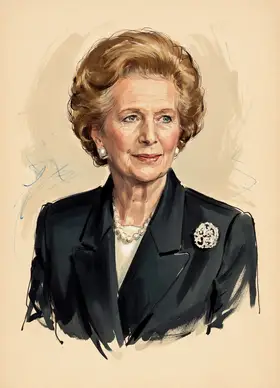
Margaret Thatcher on Privatisation
TL;DR
Margaret Thatcher strongly championed privatisation as a crucial means to reduce the state's power and enhance individual freedom and economic dynamism.
Key Points
She stated that privatization was central to ensuring "the state's power is reduced and the power of the people enhanced" as early as 1993.
Her government oversaw the privatization of major entities including British Airways, British Telecom, and British Steel during her tenure.
She was initially resistant to privatizing the railways, viewing it as a potential political disaster, though the process was later implemented by her successor.
Summary
Margaret Thatcher, as Prime Minister from 1979 to 1990, launched the privatization revolution, making it her most important and enduring economic legacy. Her core position was that government control was inherently bad because it denied people the power to choose and the opportunity to bear responsibility, asserting that privatization was essential for "reclaiming territory for freedom" and reversing "the corrosive and corrupting effects of socialism." She oversaw the sale of major state-owned businesses like British Gas, British Telecom, and British Steel, often utilizing mass share offerings to promote what she termed a "share-owning popular capitalism" and increase individual stake in the economy.
Initially, her government was politically cautious, focusing first on privatizing commercial enterprises and undertaking the popular "Right to Buy" for council housing. Following a strong re-election in 1983, the program intensified, moving toward core utilities like water and electricity, often accompanied by regulatory reform to foster competition. Although the initial dream of widespread small share ownership subsided as shares were consolidated, Thatcher viewed privatization as a systemic shift, changing attitudes so that private ownership of utilities moved from the political periphery to the center ground, a model that subsequently spread globally.
Key Quotes
Privatisation was crucial for “reversing the corrosive and corrupting effects of socialism”
“Privatisation shrinks the power of the state and free enterprise enlarges the power of the people”
In nationalisation, we are privatising and taking powers away from the Government and giving them to the people.
Frequently Asked Questions
Margaret Thatcher's primary goal was to shrink the size and power of the state, which she believed was fundamentally inefficient and denied individual choice. She aimed to enlarge the power of free enterprise and transfer ownership to the people through shareholding. This ideology was central to her mission to revive the British economy.
No, her initial privatization efforts were cautious, focusing on commercial enterprises like British Aerospace between 1979 and 1983. It was in her second term, after securing a larger mandate, that the vision expanded to include the sale of major state utilities such as British Telecom and British Gas. She was heavily influenced by thinkers like F. A. Hayek in developing this agenda.
Her success in the United Kingdom spurred a global privatization revolution that swept through developed and developing nations alike. Many countries followed Britain's lead due to widespread disillusionment with the poor performance of state-owned enterprises. This created a model of ownership and regulation that spread internationally.
Sources10
Margaret Thatcher's Privatization Legacy
Margaret Thatcher: "Privatisation shrinks the power of the state and free enterprise enlarges the power of the people"
Thatcher's golden legacy of privatisation - CapX
A short history of privatisation in the UK: 1979-2012 | Richard Seymour | The Guardian
The Thatcher privatisation legacy
What, in your opinion, has been the legacy of Margaret Thatcher's government on the UK globally and locally? : r/geopolitics
The living legacy of privatisation in the United Kingdom | Transnational Institute
Death of Thatcher – reminds us of her first loss: over water privatisation | EPSU
Thatcher and her privatisation legacy – Daniel Bowen
HC S: [Debate on the Address] | Margaret Thatcher Foundation
* This is not an exhaustive list of sources.