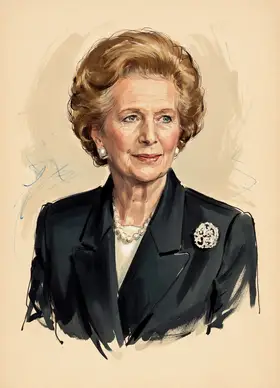
Margaret Thatcher on Hong Kong
TL;DR
Margaret Thatcher advocated for a negotiated handover of Hong Kong based on treaty obligations, securing autonomy for fifty years.
Key Points
She believed the 1898 lease for the New Territories, alongside Hong Kong Island and Kowloon held in perpetuity, needed to be addressed by treaty agreement before the 1997 deadline.
During her September 1982 meeting with Deng Xiaoping, she insisted that China could not unilaterally seize the territory, warning that it would ruin its international reputation.
The resulting 1984 Joint Declaration guaranteed Hong Kong's social and economic systems would remain unchanged for 50 years after the 1997 handover to the People’s Republic of China.
Summary
Margaret Thatcher’s core position on Hong Kong revolved around the legality and sanctity of the 1898 lease, even as she accepted the geopolitical reality that Britain could not maintain rule past the 1997 expiration date. Following her diplomatic success in the Falklands, she engaged in intense negotiations with Chinese leadership, notably Deng Xiaoping, beginning in September 1982, insisting that any change to the treaties governing the territory must occur through agreement, not unilateral abrogation. This led to the 1984 Sino-British Joint Declaration, where Britain agreed to cede sovereignty, while China guaranteed Hong Kong a high degree of autonomy, maintaining its social and economic systems for fifty years under the 'One Country, Two Systems' framework.
Despite her determination to uphold the treaty, Thatcher initially held personal reservations about consigning subjects to a communist regime, even resisting official advice that dismissed the 'wishes of the people' as unrealistic, leading her to view the final outcome as a necessary, though not ideal, resolution. Her belief in pacta sunt servanda—that agreements must be kept—was central to the negotiation strategy, aiming to use international law as a foundation to secure Hong Kong's future prosperity and way of life, which was seen as a practical benefit to China. The process itself was highly contentious, causing significant economic shock in the territory, but ultimately bound China to an international commitment, which was viewed as a victory for the international order.
Key Quotes
I am very well aware of the direction in which the Chinese are thinking. Like you, I doubt whether their objective - to leave Hong Kong in practice as it is - and their formula are compatible.
“I could walk in and take the whole lot this afternoon,”
Frequently Asked Questions
Margaret Thatcher's main objective was to secure an agreement with China over Hong Kong's future before the 1997 lease expiration, based on the validity of the existing treaties. She sought to maximize the advantages for Hong Kong's people by ensuring their prosperity and autonomy were legally guaranteed for the subsequent fifty years.
She engaged in difficult, high-stakes negotiations with leaders like Deng Xiaoping, beginning in 1982, where she stood firm on the principle that treaties must be respected, even when China insisted on reclaiming sovereignty. While she felt the ultimate agreement was good, her initial confrontational stance shocked some observers and caused immediate financial instability in the colony.
Margaret Thatcher later stated she did not regret signing the 1984 Sino-British Joint Declaration, believing it was the best possible outcome given that continued British rule was not an option. She saw the resulting agreement as having bought Hong Kong decades of freedom and upheld the important international principle that pacts should be honored or negotiated, not broken unilaterally.
Sources6
Did Britain Fail Hong Kong? | History Today
No Regrets
Hong Kong Returns to China, Part I – Association for Diplomatic Studies & Training
How to negotiate with China
Release of MT's private files for 1982 - China & Hong Kong
Mrs Thatcher and the end of British rule in Hong Kong
* This is not an exhaustive list of sources.