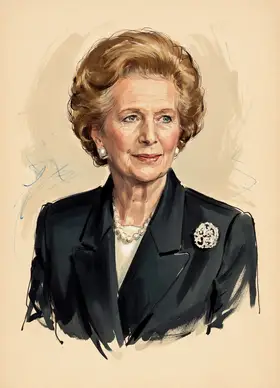
Margaret Thatcher on Government
TL;DR
Margaret Thatcher believed government's role should be minimal, focused on serving individual liberties rather than restricting them.
Key Points
She believed the central mistake of recent politics was an over-reliance on government to provide or legislate for nearly everything, leading to increased authoritarianism.
Her government sought to 'roll back the frontiers of the state' by encouraging self-provision through tax incentives, leaving the state as a foundation for basic standards.
Thatcher asserted that governments exist to serve the liberties of the people, not to restrict them, emphasizing personal responsibility over state dependence.
Summary
Margaret Thatcher's core position on government was a profound skepticism towards its extensive role, viewing large-scale state intervention as inherently authoritarian and diminishing of individual responsibility. She argued that the great mistake of recent politics was for the government to provide or legislate for almost everything, which centralized decision-making among remote bureaucrats and lessened personal involvement. Her aim was to re-establish a framework that rewarded self-reliance and charity by reducing the area of decision over which the state presided, thereby allowing the private citizen to make more of their own choices.
Her approach was driven by a belief that excessive state provision eroded the incentive to work and fostered dependence, contrasting with her own values rooted in self-help and independence. She famously articulated that when individuals cast their problems onto society, they should remember that there is no such thing as society, only individual men, women, and families, and that government can only act through people. Therefore, the government's function should be to support, not supplant, personal and family responsibility, concentrating instead on areas like hospitals where the citizen cannot provide for themselves.
Frequently Asked Questions
Margaret Thatcher strongly believed that the modern state had become too large and over-involved in citizens' lives. She advocated for a comparative reduction in government's role to increase personal responsibility and independence. This was central to her political philosophy of rolling back socialism.
She frequently expressed concern that too many people were being led to believe that the government was responsible for coping with their personal problems, such as homelessness. She stressed that people must look to themselves and their families first, as government acts only through individuals. This was tied to her assertion that individuals have entitlements but also obligations.
She rejected the notion that the government's role included controlling prices and incomes through compulsion, seeing this as repugnant and incompetent. Instead, she felt the government's primary economic role was controlling the money supply and management of demand, while fostering the conditions for private competition to flourish.
Sources5
Margaret Thatcher, individualism and the welfare state - History & Policy
Conservative Political Centre (CPC) Lecture ("What's wrong with politics?") | Margaret Thatcher Foundation
Margaret Thatcher: There's No Such Thing as Society - New Learning Online
Margaret Thatcher on Liberty - George W. Bush Presidential Center
Margaret Thatcher on Socialism: 20 of Her Best Quotes - FEE
* This is not an exhaustive list of sources.