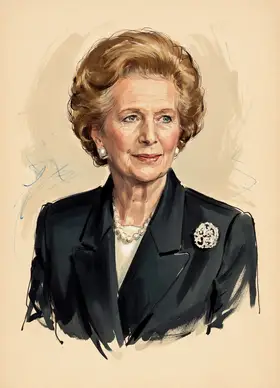
Margaret Thatcher on Falklands War
TL;DR
Margaret Thatcher firmly committed the United Kingdom to the military recapture of the Falkland Islands following the Argentine invasion in 1982.
Key Points
She announced the immediate dispatch of a naval task force on 1982-04-03 to retake the islands following the invasion.
Her government immediately rejected any negotiated settlement that would have involved a transfer of sovereignty while the islands were under Argentine occupation.
Following the surrender in June 1982, she framed the war as a defense of freedom against aggression, often linking it to broader Cold War principles.
Summary
Margaret Thatcher’s core position on the Falklands War was an unequivocal rejection of the Argentine invasion of April 1982 and a determination to expel the invading forces. She viewed the seizure of the islands as an act of unprovoked aggression against British sovereign territory and the principle of self-determination for the islanders. This stance led directly to the dispatch of a substantial naval task force to the South Atlantic, a decision she championed immediately after the invasion. She viewed the conflict not merely as a territorial dispute but as a vital test of the nation's will and moral courage in the face of international bullying.
Her response shaped her premiership, solidifying her image as a resolute leader both at home and abroad. She strongly justified the military action as necessary to uphold international law and defend the rights of the Falkland Islanders to remain British, a principle she felt trumped any calls for a negotiated settlement under occupation. Following the successful campaign, she celebrated the victory, framing it as a vindication of the values she espoused. A notable public moment occurred when she announced the successful completion of the war from a ship in the South Atlantic.
Frequently Asked Questions
Margaret Thatcher's primary motivation was the immediate restoration of British sovereignty over the Falkland Islands following the unprovoked invasion by Argentina in April 1982. She felt a strong imperative to defend the rights of the islanders to choose their own allegiance against military force. This commitment was framed as upholding international law and national resolve.
Yes, the decision to engage in the conflict drew criticism, with some political commentators suggesting that previous diplomatic efforts or the granting of independence might have averted the war. Critics also questioned the principles used to justify the conflict. Despite this, the successful military outcome bolstered her popularity significantly.
She viewed the successful outcome as a profound vindication of the decision to fight and a demonstration of the nation's will. Margaret Thatcher celebrated the victory as a moment where Britain stood up for freedom and justice in the world. She often referred to the conflict as a defining moment for her government and the country.
Sources7
Margaret Thatcher and the Falklands War
Falklands: Statements Made by The Prime Minister
Rejoice (Margaret Thatcher)
Why did Margaret Thatcher want the Falklands so badly?
Margaret Thatcher: Announcing Invasion of Falklands (1982)
Margaret Thatcher and the war's 'bogus principles' on the Falkland Islands
Falklands War: Key moments of the 1982 conflict
* This is not an exhaustive list of sources.