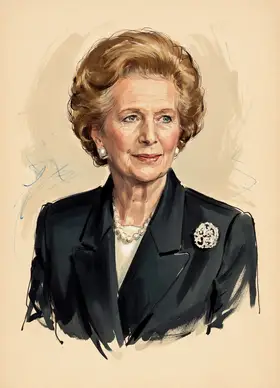
Margaret Thatcher on Euro
TL;DR
Margaret Thatcher was a staunch opponent of the euro, describing its creation as a reckless 'rush of blood to the head.'
Key Points
She described the plan for a single currency as a “rush of blood to the head” in private discussions in June 1990.
Her resistance to joining the Exchange Rate Mechanism (ERM) caused deep divisions within her administration, leading to ministerial resignations.
She warned that a single currency would necessitate huge fiscal transfers from richer to poorer regions, leading to chaos and extremism.
Summary
Margaret Thatcher was a staunch opponent of the idea of a single European currency, which she articulated clearly in private discussions around 1990. She famously told her Irish counterpart that the European Commission president Jacques Delors must have had a "rush of blood to the head" for proposing the unified currency and explicitly stated, "We are not going to have a single currency." Her core concerns revolved around the loss of national sovereignty, particularly the inability to control one's own monetary policy and taxation powers, which she believed would lead to economic chaos, mass migration, and the growth of extremism. She preferred to maintain the UK’s ability to fight inflation, wanting to keep an effective gold standard, like the Germans had with the Deutschmark, rather than ceding control to a central bank prioritizing growth and employment equally with inflation.
Her skepticism hardened significantly after she left office in 1990, making her a leading voice against further European integration. While she had supported the Single European Act and the Single Market Programme in the mid-1980s, the push for monetary union proved anathema to her governing philosophy. Her opposition to a single currency deeply divided her administration, ultimately contributing to her departure as Prime Minister. After leaving office, she became a mentor for Eurosceptics, warning that the proposed currency would cripple the continent economically by failing to synchronize disparate economies.
Key Quotes
If the divergence between different European economies is so great that even the ERM cannot contain them, how would those economies react to a single European currency? The answer is that there would be chaos of the sort which would make the difficulties of recent days pale by comparison.
Frequently Asked Questions
Margaret Thatcher's primary objection to the euro was the inherent loss of national sovereignty it demanded. She believed that relinquishing control over an independent currency and national monetary policy was economically dangerous and politically unacceptable for Britain.
No, Margaret Thatcher was firmly against the single currency. While she supported the concept of the Single Market, her opposition to monetary union hardened as the plans developed. Archives show she vehemently rejected the idea as early as 1990, calling it reckless.
She predicted that the central bank for a single currency would be hopelessly ineffective because it would have to balance conflicting objectives like employment and inflation equally. She preferred the stability offered by linking the UK currency to the Deutschmark's discipline.
Sources5
Margaret Thatcher said plan for the euro was 'a rush of blood', archives reveal
Thatcher was completely right about the Euro | The Spectator
On Europe: Margaret Thatcher's Lasting Legacy | Chatham House – International Affairs Think Tank
Bruges speech - Wikipedia
Margaret Thatcher's Warning about the creation of the Euro (1992) : r/europe
* This is not an exhaustive list of sources.