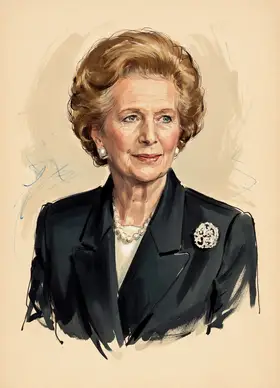
Margaret Thatcher on Big Government
TL;DR
Margaret Thatcher strongly believed that government should be small, with the state acting as a servant, not the master of the people.
Key Points
Her deliberate intent was to change Britain from a dependent society to a self-reliant, 'do-it-yourself' nation.
She opposed big government and social benefits dependency, favoring policies that promoted private ownership of assets like state industries and council housing.
She believed that government should be the umpire, not the player, a foundational principle she pursued against collectivist trends.
Summary
Margaret Thatcher was a fierce opponent of Big Government, viewing the expansion of state power as detrimental to individual liberty and national progress. Her core political intent upon taking office was to transform Britain from a dependent society into a self-reliant one, moving away from 'give-it-to-me' mentalities fostered by extensive government intervention. This conviction was evidenced by her policies of privatization, significant tax cuts, and efforts to reduce the power of trade unions, which she believed were shackling the economy. She argued that states which dwarf individual talents cannot progress, contrasting this with Western civilization's success, which was predicated on valuing the individual.
Her philosophy maintained that while government underpins the conditions for a prosperous life, it does not generate prosperity; that role belongs to individuals, families, and businesses. This stance positioned her against the prevailing post-war social democratic consensus, which she felt led to economic stagnation and excessive state control. Even upon leaving office, she asserted that the main challenge to limited government remained the constant tendency for government to expand, a pattern that Socialist or Social Democrat philosophies accelerate. She stressed that limited government does not equate to weak government, but rather one with less scope, freeing the British people to achieve greater prosperity.
Key Quotes
And to set the record straight — once again — I have never minimised the importance of society, only contested the assumption that society means the State rather than other people.
What they can't achieve in an independent, free enterprise Britain, they can hope to secure in a Euro-federalist Britain, whose people's instincts are ignored and whose parliamentary institutions are over-ridden.
Frequently Asked Questions
Margaret Thatcher was a strong opponent of Big Government, viewing its expansion as a threat to individual liberty and economic growth. She sought to reverse decades of state growth through privatization and deregulation. Her administration aimed to create a framework where government was the servant and custodian, not the master or collaborator.
She enacted significant policies like privatizing state-owned industries and limiting trade union power, intending to roll back the state's economic role. However, some analysis suggests that while the tax structure changed, total government spending as a share of GDP did not decrease consistently throughout her tenure, sometimes rising due to factors like war spending.
Her philosophy was rooted in classical liberalism and individualism, holding a greater confidence in individuals, families, and businesses than in the State. She contended that the state's role was to underpin the framework for freedom, not to generate prosperity or right all social wrongs through intervention.
Sources6
5 Lessons to Learn from Margaret Thatcher
Liberty and Limited Government by Margaret Thatcher
Speech to the International Free Enterprise dinner
Thatcherism | Political Science | Research Starters | EBSCO Research
Thatcherism is the big Tory scam that still distorts our politics
The Forgotten Lesson of Margaret Thatcher: Why Classical Liberals and Conservatives Need Each Other
* This is not an exhaustive list of sources.