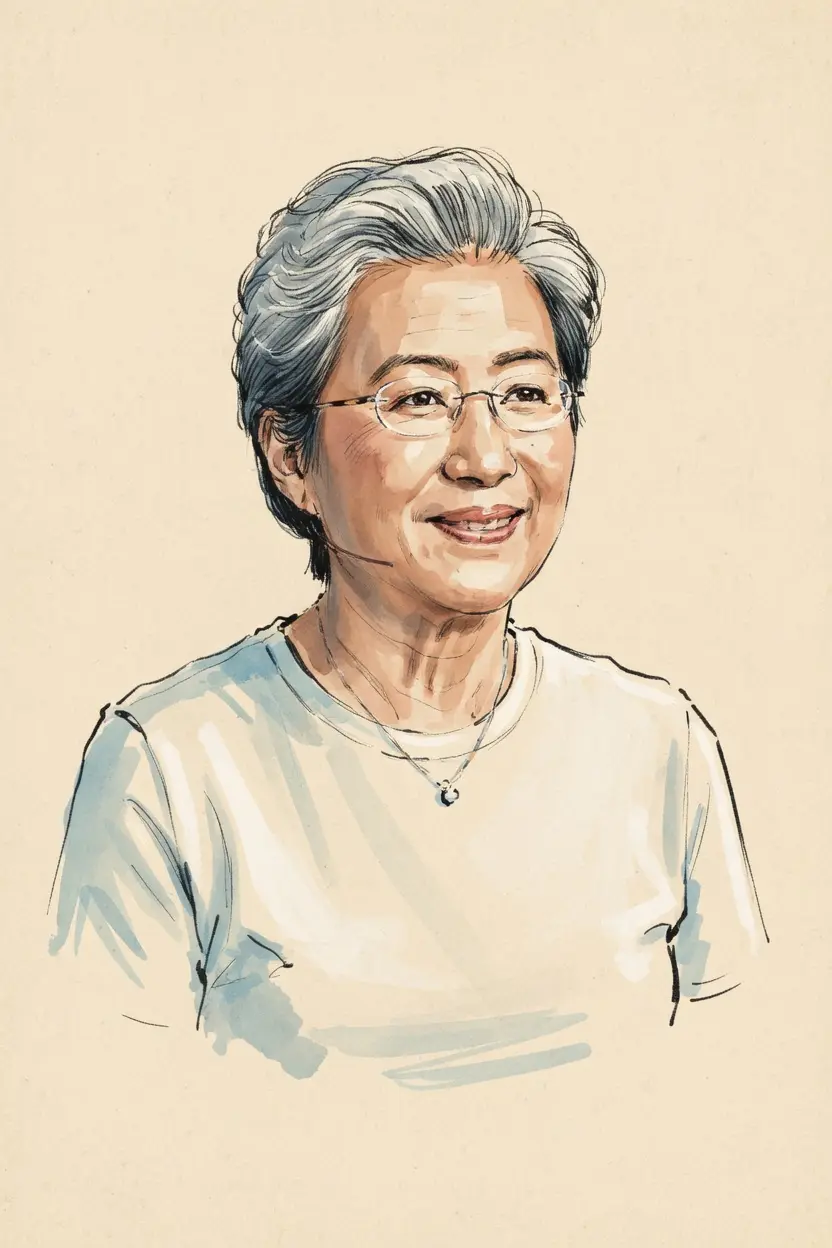
TL;DR
Lisa Su positions AMD as a direct and accelerating competitor to NVIDIA across the high-performance computing and AI chip landscape.
Key Points
She stated she does not believe there will ever be a monopoly where only one technology is used for AI pre-training.
AMD's CEO views the AI market as moving faster than anything she has seen before, resetting the competitive tempo.
She contrasts AMD's open-source software approach (ROCm) with the competitor's vertical integration, believing openness will lead to a larger developer ecosystem.
Summary
Lisa Su, the chair and CEO of Advanced Micro Devices (AMD), views NVIDIA as the primary competitor in the rapidly evolving high-performance computing and Artificial Intelligence (AI) chip markets. Her core position involves aggressively challenging NVIDIA’s market dominance by developing competing, high-performance accelerator chips and touting AMD's commitment to an open ecosystem. She has framed the AI market as a once-in-a-generation shift that is moving faster than previously anticipated, signaling a strategic focus for AMD to capture significant market share from the incumbent leader.
To compete, she emphasizes that AMD is not aiming to be a 'fast follower' but is instead racing to define the next phase of intelligence by offering integrated solutions. This involves layering its Instinct accelerators with CPUs and open software like ROCm, which she contrasts against the competitor's more vertically integrated approach. The CEO stresses that her company is focused on building the best technology and products, believing that the market will not consolidate around a single proprietary technology, thereby creating room for AMD to thrive.
Key Quotes
NVIDIA is a great company and they certainly have a very capable AI end-to-end capability.
Frequently Asked Questions
Lisa Su views NVIDIA as the central rival in the AI and high-performance computing hardware space. She is leading AMD to compete directly by developing competing accelerator chips and a full AI platform. The CEO is focused on creating the best technology to gain market share from the incumbent leader.
Her current stance reflects a strong, long-term competitive strategy against NVIDIA, particularly in AI. She has consistently pushed AMD to challenge market leaders, pivoting the company toward high-performance computing after joining AMD in 2012. Her position is one of direct competition rather than avoidance.
The AMD CEO acknowledges that NVIDIA currently directs the conversation in the AI chip world, noting their capable end-to-end AI systems. However, she asserts that the market will not settle on a single, proprietary technology. She believes AMD's focus on open systems and integrated platforms will effectively challenge this dominance over time.
Sources8
Lisa Su Runs AMD—and Is Out for Nvidia's Blood
How AMD's Lisa Su Got Under Nvidia's Skin
AMD's Lisa Su is Staring Down Nvidia and Talk of an AI ...
AMD flips the script on Nvidia with bold new vision
AMD CEO Lisa Su on the AI chip race and Nvidia
Lisa Su Runs AMD—and Is Out for Nvidia's Blood | Lauren ...
“Dream Big”: Lisa Su Talks Chips, Curiosity, and Chance
AMD's Lisa Su has already beaten Intel. Now comes Nvidia
* This is not an exhaustive list of sources.