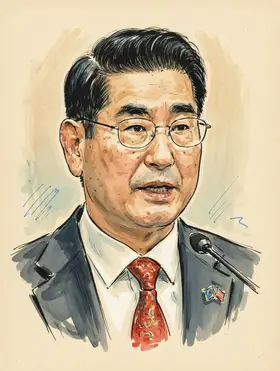
Kim Yong Hyun on KAIST (Korea Advanced Institute of Science and Technology)
TL;DR
Kim Yong Hyun is an Associate Professor in Chemical and Biomolecular Engineering at KAIST, focusing on nanoelectronics.
Key Points
He is listed as an Associate Professor in Chemical and Biomolecular Engineering at KAIST starting August 1, 2025.
His research interests at KAIST include nanoelectronics and non-volatile memory technologies based on 2D and phase-change chalcogenides.
He previously served as an Associate Professor in Materials Science and Engineering at Ulsan National Institute of Science and Technology until August 2025.
Summary
Kim Yong Hyun is documented as an Associate Professor in the Department of Chemical and Biomolecular Engineering at KAIST (Korea Advanced Institute of Science and Technology) as of August 2025. His research interests at the institution center on the development of nanoelectronics and non-volatile memory technologies utilizing 2D and phase-change chalcogenides, as well as the fundamental physics of semiconductors at reduced dimensions. The ORCID profile for Joonki Suh (0000-0002-0221-8447) lists employment at KAIST, but the search results do not explicitly detail Kim Yong Hyun's specific views or positions on KAIST's broader administrative or policy matters beyond his affiliation as a faculty member.
Prior to his current role at KAIST, he held an Associate Professor position at Ulsan National Institute of Science and Technology in Materials Science and Engineering from July 2019 to August 2025. His academic background includes a PhD in Materials Science and Engineering from UC Berkeley and an MS in the same field from Stanford University. Although his research output is extensive, the provided sources do not contain any public statements from Kim Yong Hyun regarding institutional governance, funding, or specific programs at KAIST outside of his own research area.
Key Quotes
Professor Kim Yong Hyun from the Graduate School of Nanoscience and Technology have succeeded in fluorinating a single atomic-layered graphene sample and controlling its frictional and adhesive properties.
The Center for Anthropocene Studies at KAIST (Korea Advanced Institute of Science and Technology) explores the ways in which the Anthropocene is shaped, resisted, and also transgressed in Korea.
Frequently Asked Questions
Kim Yong Hyun is an Associate Professor in the Department of Chemical and Biomolecular Engineering at KAIST as of August 2025. His primary focus is on conducting research within this department.
Kim Yong Hyun's research at the institution focuses on advanced materials and devices, specifically in the areas of nanoelectronics and non-volatile memory technologies. This includes fundamental physics studies of semiconductors at reduced dimensions.
Yes, Kim Yong Hyun was previously an Associate Professor in Materials Science and Engineering at Ulsan National Institute of Science and Technology. Before that, he completed postdoctoral research at the University of Chicago.
Sources2
Joonki Suh (0000-0002-0221-8447) - ORCID
KAIST researchers verify and control the mechanical properties of graphene
* This is not an exhaustive list of sources.