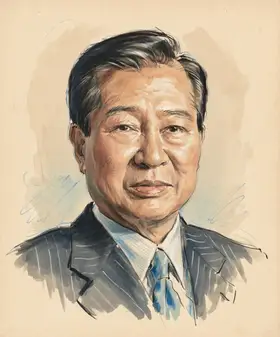
Kim Dae Jung on Roh Moo Hyun
TL;DR
Kim Dae Jung supported Roh Moo Hyun's continuation of his engagement policy, ensuring a smooth transfer of power in 2003.
Key Points
The two leaders agreed to meet frequently to manage state affairs and ensure a smooth transfer of power following Roh's victory in December 2002.
Roh Moo-hyun campaigned on a platform that included continuing the former president's engagement policy toward North Korea.
Kim Dae Jung later stated that President Roh Moo-hyun suffered humiliation and defamation during an unfair investigation, suggesting support for his successor.
Summary
Kim Dae Jung supported his successor, Roh Moo Hyun, by agreeing on the need for a smooth transition of government following Roh's election as the 16th South Korean president. At their first meeting in December 2002, Kim Dae Jung and President-elect Roh Moo Hyun agreed to work toward the peaceful resolution of the Democratic People's Republic of Korea's nuclear activities. Roh's platform explicitly promised to continue Kim Dae Jung's engagement policy toward the North, although he intended to rename his approach the “Peace and Prosperity Policy.”
Roh Moo-hyun's administration was viewed as representing a continuation of the engagement-oriented policies, or Sunshine Policy, initiated by Kim Dae-jung. While Roh promised to improve the methodology by increasing transparency and consulting the opposition, his fundamental alignment on inter-Korean engagement with the predecessor was clear. Furthermore, upon leaving office, Kim Dae Jung was treated with respect by Roh, who opted against pursuing the parliamentary investigation into the 'cash-for-summit scandal' that marred Kim's legacy.
Frequently Asked Questions
Kim Dae Jung expressed hope that Roh Moo Hyun would become a successful president following the transfer of power in February 2003. Both leaders agreed on the necessity of resolving North Korea's nuclear issue peacefully. After leaving office, Kim Dae Jung later commented on the unfair investigation Roh faced, suggesting sympathy for his successor.
Yes, Kim Dae Jung's successor, Roh Moo Hyun, campaigned on continuing the predecessor's engagement policy, which Kim championed. Roh stated his policy would not be significantly different, though he planned to improve the methodology by increasing transparency. This demonstrated continuity in their approach to inter-Korean relations.
The transition was characterized by agreement between the two leaders to ensure a smooth handover of state affairs, including frequent meetings. Kim Dae Jung expressed his hope for Roh's success as he prepared to leave office in February 2003. Roh's platform was largely built on continuing the progressive agenda of the outgoing administration.
Sources4
Kim Dae-jung, Roh Moo-hyun Meet on State Affairs
The Past as Prologue: President Kim Dae Jung's Legacy And President Roh Moo-Hyun's Policy Issues And Future Challenges
Sunshine policy | Korean history | Britannica
President Moon Jae-in and Sunshine Policy 3.0 | PIIE
* This is not an exhaustive list of sources.