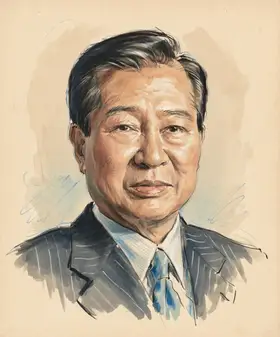
Kim Dae Jung on Political Ideology
TL;DR
Kim Dae Jung was a staunch advocate for liberal democracy and market economics, blending idealism with pragmatic reform.
Key Points
Kim Dae Jung strongly advocated for the democratization of South Korea throughout the 1970s and 1980s against military rule.
He promoted the 'Mass Economy Theory' which aimed to balance the power of large conglomerates with support for small and medium enterprises.
As President, he pursued the 'Sunshine Policy' of engagement with North Korea, predicated on his belief in peaceful coexistence and dialogue.
Summary
Kim Dae Jung's political ideology was fundamentally rooted in a strong commitment to liberal democracy, human rights, and a socially conscious market economy. His stance developed through decades of opposition to authoritarian regimes, solidifying his belief that political freedom was a prerequisite for sustainable economic development. He championed a system that integrated market efficiency with a strong social safety net, a concept sometimes referred to as his 'Mass Economy Theory,' which sought to bridge the gap between large conglomerates and smaller enterprises. This ideological commitment guided his actions both as a dissident and as President.
His approach represented a synthesis, drawing from both Western liberal traditions and specific Korean socio-economic realities. While embracing market principles essential for South Korea's growth, he consistently critiqued unchecked capital concentration and sought to expand economic opportunities to the broader populace. This ideological framework informed his landmark Sunshine Policy toward North Korea, viewing engagement as a necessary, democratic, and pragmatic tool for achieving long-term peace and unification.
Frequently Asked Questions
Kim Dae Jung's core political ideology centered on achieving and consolidating liberal democracy in South Korea. He combined this commitment to political freedom with a belief in a socially responsible market economy that benefited the majority of citizens.
He viewed economic policy as intrinsically linked to political stability and justice, championing his 'Mass Economy Theory.' This theory sought to reform the existing economic structure by fostering the growth of smaller firms alongside established business conglomerates.
While his commitment to democracy remained constant, the expression of his ideology evolved from outright opposition under authoritarian rule to pragmatic governance. His approach incorporated market mechanisms more fully upon entering the presidency in 1998.
Sources10
Lessons from Nobel Peace Prize Winner 2000 Kim Dae Jung
Kim Dae-jung's sunshine policy: A case of political opportunism?
The politics of policy ideas and Kim Dae-jung's Mass Economy Theory
South Korea Since 1980: Democratic Consolidation and Social Change
The politics of policy ideas and Kim Dae-jung’s Mass Economy Theory
The Politics of Policy Ideas and Kim Dae-jung's Mass Economy Theory
South Korea Since 1980: Democratic Consolidation and Social Change
The Role of Civil Society in South Korea's Democratization
KIM DAE JUNG
McCarthyism in South Korea: The Naked Truth and History of Color Politics
* This is not an exhaustive list of sources.