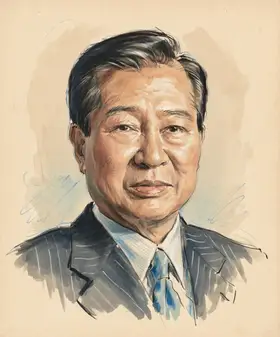
Kim Dae Jung on North Korea
TL;DR
Kim Dae Jung strongly advocated for peaceful engagement with North Korea through his comprehensive "Sunshine Policy" to foster reconciliation.
Key Points
He arranged the first-ever inter-Korean summit with Kim Jong Il in Pyongyang in June 2000.
His policy of engagement towards the North was termed the "Sunshine Policy" for which he received the Nobel Peace Prize in 2000.
Following the 2000 summit, allegations arose that his administration had paid North Korea approximately $500 million to secure the meeting, leading to the cash-for-summit scandal.
Summary
Kim Dae Jung's core position regarding North Korea was encapsulated by his "Sunshine Policy," an engagement strategy aimed at reducing tensions and laying the foundation for peaceful reunification through warmth and friendliness, rather than just confrontation. This policy was the political arena that most reflected his personality and leadership, leading to unparalleled interaction between the two Koreas during his 1998-2003 presidency and earning him the 2000 Nobel Peace Prize. A key milestone of this approach was the historic Inter-Korean Summit in June 2000 with the northern leader, Kim Jong Il, which resulted in allowing separated family members to meet, and cooperation in transport, sports, and culture.
Despite the overall goal of peace, the policy faced significant practical challenges and controversy; for instance, allegations emerged that his administration secretly funneled substantial funds to the North to secure the summit, known as the cash-for-summit scandal. Furthermore, while he believed engagement was the key to improving human rights in the North by opening the country, the North continued developing weapons, and critics argued that any transferred funds might have been used for military purposes, thus weakening security. His leadership style regarding the North was noted as flexible, shifting from an advocate to a pragmatic approach depending on contextual constraints.
Key Quotes
“... in coming up with that phrase we've taken into consideration the documents that came out of the G-8 Okinawa Summit and various other international consultations that the United States was part of. This in no way reflects our position on the NMD issues. This is not an indication of our opposition to the NMD...
Frequently Asked Questions
Kim Dae Jung's primary policy toward North Korea was the "Sunshine Policy," an engagement strategy focused on improving relations through warmth and reconciliation rather than just confrontation. He implemented this policy to create a foundation for eventual peaceful reunification of the Korean Peninsula.
Yes, the policy facilitated significant interactions, including the first-ever inter-Korean summit in 2000 which allowed for highly anticipated reunions of separated families. His efforts were recognized with the 2000 Nobel Peace Prize for promoting reconciliation.
The policy faced controversy, most notably due to allegations that hundreds of millions of dollars were secretly transferred to the North to facilitate the 2000 summit, which became known as the cash-for-summit scandal. Additionally, critics questioned the policy's effectiveness against North Korea's continued weapons development.
Sources7
Remarks by President Bush and President Kim Dae-Jung of South Korea
Kim Dae-Jung's Leadership as Relevant to the Sunshine Policy (1998-2003)
The late Kim Dae-jung of South Korea leaves a complex legacy that changed the Korean peninsula | Whitworth University News
Cash-for-summit scandal - Wikipedia
Kim Dae-jung – Facts - NobelPrize.org
Kim Dae Jung: A Future Leader's Moment of Truth | Brookings
* This is not an exhaustive list of sources.