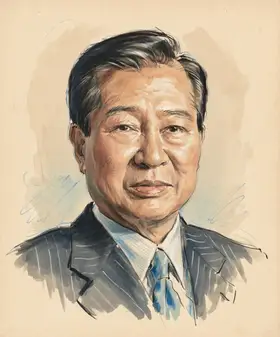
Kim Dae Jung on Japan
TL;DR
Kim Dae Jung prioritized overcoming historical conflict to build a future-oriented, cooperative partnership with Japan.
Key Points
He accepted Prime Minister Obuchi’s expression of deep remorse and apology for Japan’s colonial rule in the 1998 Joint Declaration.
In 2001, he turned down a meeting with a Japanese delegation to protest Tokyo’s decision regarding history textbooks that downplayed wartime atrocities.
During his 1971 presidential campaign, he advocated for easing tensions with Japan by securing guarantees for Korean security from major powers, including Japan.
Summary
Kim Dae Jung’s core position regarding Japan was a commitment to forging a future-oriented partnership, even while insisting that this required Japan to squarely face the past. This stance was most clearly evidenced by his negotiation of the Japan–South Korea Joint Declaration of 1998 with Prime Minister Keizō Obuchi. In this declaration, he accepted the Prime Minister’s expression of deep remorse and heartfelt apology for the suffering caused by Japan’s colonial rule and, in return, expressed his view that both nations must move beyond their unfortunate history toward reconciliation and good-neighborly cooperation. This proactive approach sought to balance historical accountability with pragmatic engagement to enhance bilateral relations for the 21st century, which included cultural opening and security coordination.
This stance evolved from a position of strong opposition during his time as a dissident under authoritarian rule, where he faced threats, including a kidnapping in Japan in 1973 by South Korean agents. While his presidency marked a distinct shift toward reconciliation and cooperation—a path often contrasted with later, more confrontational administrations—it was not without friction. For instance, in 2001, he refused to meet Japanese envoys over their government's handling of history textbook revisions, showing his willingness to temporarily halt positive momentum to press for accountability on historical issues.
Key Quotes
Japan needs true courage to squarely face the past… and South Korea needs to correctly evaluate Japan's changing attitude and find hope in future possibilities
... we should forgive gladly because it leads to peace and reconciliation
Frequently Asked Questions
Kim Dae Jung's most significant achievement in relations with Japan was securing the Japan–South Korea Joint Declaration of 1998. Through this, he established a foundation for a future-oriented partnership based on mutual respect and reconciliation. He managed to get an explicit apology from the Japanese Prime Minister while moving relations past immediate historical disputes.
No, his view evolved. As a dissident who spent time in exile, he was kidnapped in Tokyo in 1973 by agents of the South Korean government, highlighting a period of severe antagonism and danger. However, as president, he consciously chose a path of reconciliation, prioritizing future stability over dwelling on past grievances, though he would still confront Japan on history issues when necessary.
Kim Dae Jung balanced a strong demand for Japan to acknowledge its past wrongs with a desire to build a forward-looking relationship. He accepted Japan's apology in 1998 as a sincere first step toward overcoming history. However, he demonstrated that this could be paused, as shown when he refused meetings over controversial history textbooks in 2001.
Sources9
Japan–South Korea Joint Declaration of 1998
Japan-Republic of Korea Joint Declaration A New Japan-Republic of Korea Partnership towards the Twenty-first Century
Opposition Must Reflect on Its Own History with Japan
What Yoon Could Learn From Kim Dae-jung's Dealings With Japan
A Missed Opportunity to Commemorate a Positive Moment in Korea-Japan Relations
Kim Dae-jung Refuses to Meet Japan Envoys
On 8 August 1973, Kim Dae-jung was kidnapped and almost killed in Japan by South Korean agents.
Kim Dae-jung's Role in the Democratization of South Korea
[Column] Forsaking Kim Dae-jung's path, Korea follows Abe's plan for Seoul-Tokyo relations
* This is not an exhaustive list of sources.