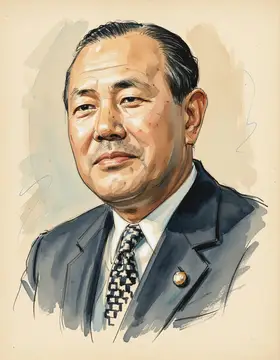
Kakuei Tanaka on Prime Ministership
TL;DR
Kakuei Tanaka held significant behind-the-scenes influence over the Prime Ministership and was a prime candidate for the role himself.
Key Points
As a major contender, Kakuei Tanaka stated that LDP presidential contests, which determine the Prime Minister, were mostly about personality differences between candidates.
He commented in 1972 that Japanese Prime Ministers average a two-year term, contrasting with the longer term of the US President, partly due to party rules preventing overly long tenures.
Tanaka remained the most influential politician in the LDP and dominated politics from behind the scenes even after his 1974 resignation as Prime Minister and subsequent conviction.
Summary
Kakuei Tanaka held a strong position of influence within Japan's ruling Liberal Democratic Party (LDP), viewing the Prime Ministership as the ultimate political prize attainable through party presidency. As a contender for the post, he engaged in factional politics, positioning himself against rivals like Takeo Fukuda, and commented on the process, noting that leadership contests were primarily a matter of personality. He discussed the mechanics of the premiership with foreign officials, observing that Japan’s parliamentary system resulted in a shorter average tenure for a Prime Minister compared to the US President.
Even after stepping down from the premiership, Tanaka's standing remained formidable; he continued to dominate politics from behind the scenes as the head of his LDP faction, suggesting his influence was not solely contingent upon holding the top office. His career was marked by intense political maneuvering, leading to his eventual downfall amid bribery scandals, yet his electoral support remained high even after being convicted, highlighting a complex relationship with the electorate regarding his fitness for the highest office.
Frequently Asked Questions
Kakuei Tanaka viewed the Prime Ministership as an achievable goal through his strong position as a faction leader within the LDP. He directly discussed the path to the premiership with foreign officials, indicating his active interest and readiness for the top job.
Yes, Kakuei Tanaka served as the Prime Minister of Japan, holding the office from July 1972 until December 1974. His premiership ended amidst growing political pressure and economic difficulties.
Yes, Kakuei Tanaka remained highly influential even after resigning; he continued to be Japan's most powerful politician from behind the scenes as the head of his LDP faction. This influence persisted until he suffered a stroke in 1985.
Sources6
Japanese Ex-Prime Minister Concedes He Met With Lockheed President
Foreign Relations of the United States, 1969–1976, Volume XIX, Part 2, Japan, 1969–1972 Document 121
JAPAN: Trouble for Tanaka | TIME
The second life of Kakuei Tanaka
Why The Wicked Sleep: The Prosecution of Political Corruption in Postwar Japan
* This is not an exhaustive list of sources.