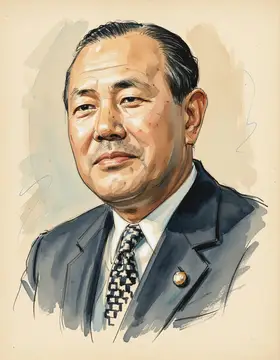
Kakuei Tanaka on Lockheed Scandal
TL;DR
Kakuei Tanaka maintained he was made a scapegoat by political rivals for common practices, leading to his conviction.
Key Points
He was arrested on July 27, 1976, primarily on charges related to violating foreign exchange restrictions, though bribery was central to the case.
The Tokyo court found him guilty on October 12, 1983, sentencing him to four years in prison, a verdict he appealed until his death in 1993.
Many of his supporters viewed the scandal as an effort by American multinational corporations to remove the Prime Minister due to his hard-line trade stance.
Summary
Kakuei Tanaka's position regarding the Lockheed Scandal, which surfaced in 1976, centered on the assertion that he was made a scapegoat by political opponents for endemic practices within the Japanese political system. Testimony from a Lockheed executive revealed that approximately $1.8 million in bribes were channeled to Tanaka’s office to secure the sale of L-1011 aircraft to All Nippon Airways. While he was arrested and eventually found guilty in 1983 of violating foreign exchange laws, his defense suggested that the payment would have typically been treated as a political contribution, which was common in the era.
Despite the serious nature of the charges and his subsequent conviction and four-year prison sentence, Tanaka refused to resign from the Diet and maintained substantial political influence through his faction until his ill health forced his retirement in 1989. His belief that the establishment had betrayed him by not protecting him as past leaders had been—through an intervention by the Minister of Justice—fueled his anger and post-scandal political maneuvering. This episode highlighted the tension between common 'money-power politics' and the formal legal boundaries being enforced in his case.
Frequently Asked Questions
Kakuei Tanaka was found guilty by a Tokyo court on October 12, 1983. He was sentenced to four years in prison and a fine. However, he remained free while his appeal process continued until his death in 1993.
Tanaka believed he was made a scapegoat by his political opponents for practices that were historically common within the Japanese political establishment. He felt betrayed when the expected intervention from the Minister of Justice, which had saved other leaders, did not materialize for him.
The scandal led directly to his arrest in 1976 and his subsequent conviction, but it did not immediately end his political career. Tanaka remained a powerful Diet member and kingmaker for his faction, retaining his seat by an unprecedented margin in the December 1983 election.
Sources7
Lockheed bribery scandals - Wikipedia
Lockheed Scandal 40 years on: The downfall of Prime Minister Kakuei Tanaka
Tanaka Is Guilty In Bribery Trial
Lockheed Is Implicated in Bribing Foreign Officials | Law | Research Starters | EBSCO Research
TIL that the Lockheed Scandal caused Prime Minister Kakuei Tanaka to be arrested : r/todayilearned
Tanaka Kakuei, Structural Corruption, and the Advent of Machine Politics in Japan
* This is not an exhaustive list of sources.