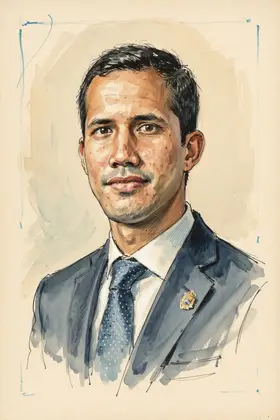
Juan Guaidó on United States
TL;DR
Juan Guaidó viewed the United States as the foremost international backer whose recognition was crucial for his interim presidency.
Key Points
The U.S. formally recognized him as Interim President on January 23, 2019, based on the National Assembly's invocation of the constitution.
He previously attended the U.S. State of the Union address as an invited guest of the President in February 2020.
The U.S. recognized him and the last democratically elected National Assembly as of January 5, 2021, while rejecting the subsequent election.
Summary
Juan Guaidó's core position regarding the United States was one of seeking and accepting robust political, diplomatic, and economic support, stemming from the U.S. recognition of him as the legitimate Interim President of Venezuela in January 2019. This recognition, made by the then-president, was seen as a critical move that formally acknowledged the 2015 National Assembly as the last democratically elected body and provided a legal basis for his claim against Nicolás Maduro. This pivotal act served to strengthen his political movement internationally and grant him access to Venezuelan assets held in the U.S., which he considered vital for his cause.
The relationship evolved over time, with subsequent administrations maintaining support for the democratically elected National Assembly and Guaidó as Interim President, although the nature of support shifted toward encouraging negotiated solutions. While early U.S. pressure tactics, like sanctions, were heavily linked to his leadership, his international standing, and consequently his leverage with the U.S., saw an erosion as the political stalemate in Venezuela persisted. He continued to engage with U.S. officials, including attending a State of the Union address, underscoring the foundational importance of the U.S. as his chief international supporter.
Key Quotes
"For an agreement to be successful, there has to be sufficient pressure for a dictatorship to give in."
"What they refer to as socialist in the United States is what we'd call a Social Democrat here."
Frequently Asked Questions
Juan Guaidó viewed the United States as his most critical international ally, especially after the U.S. recognized him as the legitimate Interim President in 2019. His political strategy heavily relied on the diplomatic and economic support provided by Washington, according to historical accounts.
Support has continued across different U.S. administrations, although the focus evolved; for instance, President Biden's administration underscored recognition while emphasizing Venezuelan-led negotiations. However, waning international support, including from the EU, meant the U.S. often remained the key backer.
The initial U.S. recognition gave Guaidó an explicit legal basis for his interim presidency and access to frozen Venezuelan assets, which he considered crucial. He maintained engagement with U.S. leaders to secure continued backing for the democratic transition.
Sources7
The United States Continues To Recognize Interim President Guaidó and the Last Democratically Elected National Assembly in Venezuela
Venezuela opposition leader Juan Guaidó to attend State of the Union
Readout of President Biden's Call with Venezuelan Interim President Juan Guaidó
Statement Announcing United States Recognition of National Assembly President Juan Gerardo Guaidó Márquez as Interim President of Venezuela
The Battle for Democracy in Venezuela: A Conversation with Former Interim President Juan Guaidó
What Does It Mean for the United States to Recognize Juan Guaidó as Venezuela's President?
Why Is International Support Falling for Venezuela's Guaidó? – Inter-American Dialogue
* This is not an exhaustive list of sources.