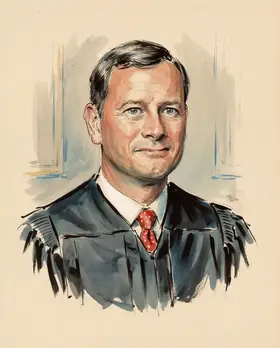
John Roberts on Voting Rights
TL;DR
John Roberts has consistently worked to undermine key provisions of the Voting Rights Act throughout his career, both as a lawyer and as Chief Justice.
Key Points
In 2013, he wrote the majority opinion in Shelby County v. Holder, invalidating Section 5 of the VRA because the coverage formula was outdated.
As a Reagan administration lawyer in the early 1980s, he drafted memos arguing against an amendment that would strengthen Section 2 to ban practices with discriminatory effects.
He joined the majority in Brnovich v. DNC (2021), which made it significantly harder for voters to successfully challenge state voting policies under the VRA Section 2 effects test.
Summary
John Roberts, as Chief Justice, has presided over a judicial trend that has significantly weakened the Voting Rights Act (VRA) through key Supreme Court opinions. This jurisprudence includes invalidating the VRA's Section 5 preclearance formula in Shelby County v. Holder (2013), which had required jurisdictions with a history of discrimination to seek federal approval for voting changes. He also joined the majority in Brnovich v. Democratic National Committee (2021), which established stricter standards for challenging voting practices under Section 2's effects test. Critics assert that his tenure reflects a continuation of his earlier work as a young lawyer in the Reagan administration, where he actively opposed strengthening Section 2's ability to block policies with discriminatory effects.
This consistent jurisprudence suggests a long-standing skepticism toward race-conscious remedies designed to ensure equal political opportunity, prioritizing a colorblind view of the Constitution over historical context. His opposition stems from viewing such provisions as the “most intrusive interference imaginable” into state processes, a position first articulated in 1982 memos. While he has authored opinions preserving some aspects of the VRA, such as in Allen v. Milligan, these actions are often seen as tactical or narrow rulings that do not reverse the broader trajectory set by decisions like Shelby County and his consistent favoring of standards that make proving discrimination more difficult.
Frequently Asked Questions
John Roberts holds a position critical of expansive federal oversight under the Voting Rights Act, which he views as intrusive federal interference in state processes, according to analysis of his career. He has consistently voted to narrow its scope, most notably by striking down the Section 5 preclearance mechanism in 2013. Observers note that his judicial stance reflects his earlier legal work opposing provisions designed to address discriminatory effects.
While John Roberts stated during his 2006 confirmation hearing that he had no issue with the existing VRA, his subsequent actions suggest a consistent opposition to its core enforcement mechanisms. Critics point to his early legal career opposing the effects test as evidence that his current jurisprudence is a long-term project. Therefore, his stance appears consistent in its conservative outcome, though perhaps more guarded in its presentation over time.
John Roberts has expressed concern that Section 2's effects test—which bars policies with a discriminatory effect, regardless of intent—might improperly elevate race in political power allocation. As a young lawyer, he argued against codifying this test, and as Chief Justice, he has joined opinions that narrow its application. In Allen v. Milligan, he affirmed that Section 2 does not create a right to proportional representation.
Sources5
The Supreme Court Is Being Tested on History Once Again
Chief Justice Roberts's Vendetta Against the Voting Rights Act
Killing the Voting Rights Act Is John Roberts's Life's Work | Balls and Strikes
John Roberts Takes Control on Voting Rights
Roberts on Voting Rights Act
* This is not an exhaustive list of sources.