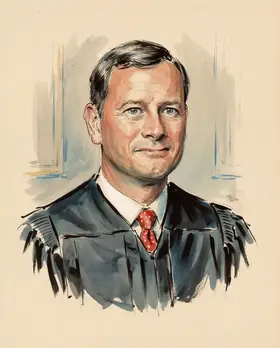
John Roberts on Tariffs
TL;DR
Chief Justice John Roberts authored the opinion limiting the President's unilateral authority to impose sweeping tariffs under emergency law.
Key Points
He wrote that the words in IEEPA cannot support the President's asserted power to impose tariffs or duties.
The Chief Justice held that the expansive tariffs failed the major questions doctrine test because Congress did not clearly delegate the power of the purse.
His opinion on February 20, 2026, involved a 6-3 decision rejecting the executive's reliance on IEEPA for tariff imposition.
Summary
John Roberts, as Chief Justice, authored the majority opinion that struck down sweeping tariffs imposed by the President, finding they exceeded the authority granted by the International Emergency Economic Powers Act (IEEPA). He asserted that the words "regulate" and "importation" within IEEPA could not support the power to impose duties or taxes, a power explicitly granted to Congress first in the Constitution. He notably relied on the major questions doctrine, arguing that such a consequential delegation of the "core congressional power of the purse" would require clear statutory language from Congress, which IEEPA lacked.
His opinion emphasized judicial restraint by stating the Court claims no special competence in economics but must fulfill its role under Article III by examining the text and context of the statute. Roberts noted that the interpretation sought by the executive branch would grant the President power to unilaterally impose unbounded tariffs, free from the procedural limits found in other explicit tariff statutes. This stance demonstrates a consistent adherence to limiting executive overreach, particularly when Congress holds a primary enumerated power, irrespective of the administration involved.
Frequently Asked Questions
Chief Justice John Roberts holds that the President lacks the unilateral statutory authority to impose sweeping tariffs under IEEPA, according to his opinion from February 20, 2026. He believes that the power to impose such duties is primarily a congressional power. Therefore, his position is to strictly limit executive authority in this area by enforcing clear statutory delegation.
No, John Roberts did not side with the President in the recent tariff case, as reported on February 20, 2026. He authored the majority opinion concluding that the President's use of IEEPA to impose tariffs exceeded his delegated authority. This ruling overturned the executive action based on textual interpretation and separation of powers.
In the tariff ruling, John Roberts applied the major questions doctrine to find the executive's action invalid, as stated on February 20, 2026. He argued that the Constitution reserves the "core congressional power of the purse" for the legislature. He concluded that Congress must delegate such a highly consequential power with explicit language, which IEEPA failed to provide.