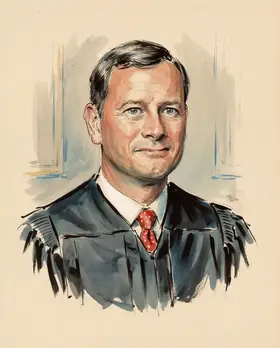
John Roberts on Same-Sex Marriage
TL;DR
Chief Justice John Roberts dissented from the Supreme Court decision mandating nationwide same-sex marriage recognition.
Key Points
He authored a vehement dissent in the 2015 decision Obergefell v. Hodges, arguing the Court was acting as a legislature, not applying law.
In his dissent, he acknowledged the social appeal of same-sex marriage but insisted the decision to change the definition of marriage belonged to the people via the democratic process.
Roberts joined the majority in the 2017 per curiam decision Pavan v. Smith, which rejected an Arkansas Supreme Court ruling that denied nonbiological parents in same-sex couples the ability to be listed on a child's birth certificate.
Summary
John Roberts, as Chief Justice, authored a strong dissent in the landmark 2015 Supreme Court case Obergefell v. Hodges, which established a constitutional right to same-sex marriage. His core argument was jurisdictional and procedural: that the Court overstepped its judicial bounds by ordering all states to license and recognize same-sex marriage, viewing it as an act of will rather than legal judgment based in the Constitution. He explicitly stated that the question of whether same-sex marriage is a good idea should be decided by the people through their elected representatives, not by the judiciary, which he characterized as an unelected committee of nine acting as a legislature.
Roberts expressed concern that the majority's substantive due process reasoning in Obergefell broke sharply with precedent by not adhering strictly to rights "objectively, deeply rooted in this Nation's history and tradition," which he argued was necessary to avoid an "unprincipled approach" reminiscent of Lochner v. New York. While he acknowledged the strong arguments for fairness and the appeal of expanding commitment recognition, he maintained that the fundamental issue was who decides the definition of marriage. Furthermore, his earlier dissent in United States v. Windsor suggested that this focus on state power to define marriage would be brought to bear in future cases concerning state marriage definitions.
Frequently Asked Questions
Chief Justice John Roberts was firmly against the Supreme Court's 5-4 decision in Obergefell v. Hodges to legalize same-sex marriage nationwide, according to voting records. He authored a dissent stating the majority took the "extraordinary step of ordering every State to license and recognize same-sex marriage". He believed this was an unconstitutional judicial act usurping the role of the states and the people.
Yes, John Roberts worked behind the scenes in a pro bono capacity for the plaintiffs in Romer v. Evans in 1996, which struck down a Colorado constitutional amendment targeting gay rights. Some observers speculated that his strategic advice in Romer was "absolutely crucial" for the argument before the Court.
While his 2015 dissent was strong, John Roberts has shown a willingness to uphold certain rights related to same-sex marriage since then. For instance, in 2017, he joined the majority in Pavan v. Smith, which protected parental rights for same-sex couples, according to case analysis. This suggests a potential focus on institutional legitimacy or established precedent over his initial strict view on the constitutional basis for the right itself.
Sources6
Key quotes from the Supreme Court's same-sex marriage decision
Why Chief Justice John Roberts Might Support Gay Marriage
John Roberts’s Gay-Rights Surprise
The Initial Appeal of Chief Justice John Roberts' Dissent in Obergefell v. Hodges
Will Chief Justice Roberts Save Same-Sex Marriage?
Gay-Rights Skeptic John Roberts Urged to Make Supreme Court History
* This is not an exhaustive list of sources.