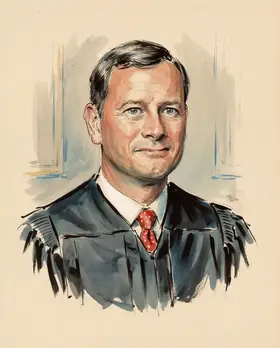
John Roberts on Roe v. Wade
TL;DR
John Roberts agreed to uphold a state abortion ban but opposed fully overturning the constitutional right established by Roe.
Key Points
He filed a concurring opinion in the 2022 Dobbs case, agreeing to uphold Mississippi's 15-week abortion restriction.
He disagreed with the majority's rationale to overturn Roe v. Wade and Casey v. Planned Parenthood entirely in the final ruling.
Roberts argued that the viability line should be discarded in favor of a standard ensuring a woman has a reasonable opportunity to choose abortion.
Summary
John Roberts took a distinct position in the Supreme Court's decision to overrule Roe v. Wade in Dobbs v. Jackson Women's Health Organization. He filed an opinion concurring in the judgment, agreeing with the majority to uphold Mississippi's 15-week abortion ban, but he disagreed with the majority's rationale to completely overturn both Roe and Planned Parenthood v. Casey. Roberts argued that a narrower decision was sufficient to decide the case by rejecting the problematic viability line established in the precedents. He proposed discarding the viability standard but leaving the question of rejecting any right to abortion for another day, believing this path would be markedly less unsettling to the legal system.
His rationale centered on recognizing that a woman's right to choose should ensure a reasonable opportunity to obtain an abortion, suggesting a standard based on when a real choice is provided, rather than solely on fetal viability outside the womb. The majority opinion countered his approach, asserting that his concurrence failed to offer a principled basis for its rule and would only prolong the turmoil created by the precedent. Ultimately, the majority voted 5-4 to overturn Roe, while Roberts joined the broader ruling that upheld the Mississippi law.
Frequently Asked Questions
John Roberts's position on Roe v. Wade, as expressed in the Dobbs decision, was to discard the viability standard but stop short of fully overturning the precedent, according to his concurring opinion. He agreed that the Mississippi 15-week ban should be upheld, but he wanted a narrower ruling that avoided eliminating the constitutional right entirely, told reporters in July 2022.
No, John Roberts did not join the majority opinion that fully overturned Roe v. Wade in the 2022 Dobbs case, according to voting records. While he voted to uphold the Mississippi law, which restricted abortions after 15 weeks, he concurred only in the judgment, not the rationale for overturning the prior ruling.
Chief Justice Roberts disagreed with the majority because he believed overturning Roe and Casey was a 'serious jolt to the legal system' that was unnecessary to decide the Mississippi case, as stated in his opinion. He preferred discarding only the viability line and leaving the broader question of any right to abortion for a later day, according to reporting on the ruling.
Sources7
Why Did Chief Justice Roberts Disagree With Overturning Roe v. Wade?
Chief Justice John Roberts defends the Supreme Court as people's confidence wavers
Chief Justice John Roberts says court has to 'regain trust' after Roe v. Wade decision
Chief Justice John Roberts says court has to 'regain trust' after Roe v. Wade decision
20 years under John Roberts: A dramatic rightward turn for US Supreme Court
Supreme Court overturns Roe v. Wade: Here's what you need to know about the decision
Supreme Court ruling on abortion: What you need to know
* This is not an exhaustive list of sources.