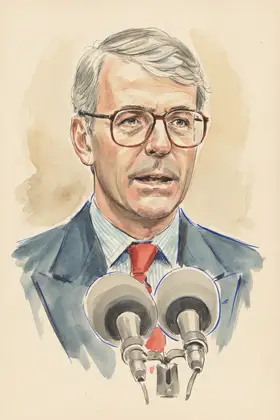
John Major on Thatcher
TL;DR
John Major maintained respect for Margaret Thatcher's historical stature while privately resenting her autocratic style and seeking political distance.
Key Points
He secretly prepared a leadership bid by having his wife type a letter of nomination for the second round of the November 1990 contest while publicly supporting her.
Major resented her autocratic style and her subsequent desire to act as a 'back seat driver' after he became Prime Minister.
He viewed her as a 'very big measure to be measured against' and acknowledged she was 'right for her time,' suggesting she was not right for the contemporary political climate of consensus.
Summary
John Major succeeded Margaret Thatcher in November 1990, taking over a Conservative Party needing unity after her divisive tenure. He sought to balance continuity with Thatcherism, such as pushing the privatisation of British Rail, with a move toward a more conciliatory, 'One-Nation Tory' style. Major resented what he saw as her autocratic approach and her attempts to be a 'back seat driver' of his premiership after she left office.
His leadership was characterized by an effort to break free from her long shadow, creating a personal image that contrasted sharply with the 'Iron Lady'. While stating on the day she died that she was a 'very great Prime Minister' right for her time, he also acknowledged that her style would not suit today's consensus politics, indicating an evolution from his initial loyalist image. Major's early career even included a significant row with her before she unexpectedly promoted him.
Frequently Asked Questions
John Major's position is complex, showing deep respect for Margaret Thatcher's historical achievements while simultaneously expressing resentment over her governing style and attempts to interfere after her premiership. He positioned himself as continuing her core economic principles while shifting the tone to be more inclusive and less confrontational, according to historical analysis.
Yes, John Major experienced significant tensions with Margaret Thatcher, which included a fierce row early in their relationship after he expressed an opinion she disliked, even though she subsequently promoted him. Upon succeeding her, he actively sought to move out of her shadow and disliked her attempts to influence his government.
In an ITV interview following her death in April 2013, John Major stated that she would be remembered as a 'very great Prime Minister' who was right for her era. He noted that while she could be pragmatic, she eventually lost connection with the electorate, which caused things to go wrong in her final years.
Sources6
Did he break free? Some reflections on John Major's tensions with Margaret Thatcher
Major plotted to replace Thatcher
“Caring” John Major : portrait of a Thatcherite as a One-Nation Tory
Sir John Major's ITV Interview following the death of Baroness Thatcher – 8 April 2013
John Major: I was reluctant to do the 'soapbox' broadcast
Major Succeeds Thatcher as British Prime Minister
* This is not an exhaustive list of sources.