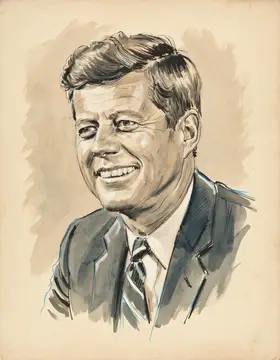
John F. Kennedy on War
TL;DR
John F. Kennedy believed mankind must end war before modern weapons end mankind, advocating for peace through strength.
Key Points
He called for a global alliance to combat the common enemies of mankind: tyranny, poverty, disease, and war itself, in his 1961 Inaugural Address.
Kennedy proposed a program for general, complete, and strictly internationally controlled disarmament in a 1961 address to the UN General Assembly.
He stated in 1962 that the graduates must have a responsibility to deter war as well as to fight it, noting basic problems are not susceptible to a final military solution.
Summary
John F. Kennedy articulated a profound concern regarding the existential threat of modern warfare, particularly nuclear conflict, throughout his presidency. In his 1961 Inaugural Address, he pledged to "pay any price, bear any burden... to assure the survival and the success of liberty," while simultaneously urging a quest for peace to avoid the "dark powers of destruction." This dual focus highlighted his view that while armed preparedness was necessary for deterrence, the ultimate goal was to dismantle the capacity for conflict. He believed that in the nuclear age, war was no longer a rational alternative for resolving disputes, stating that "Mankind must put an end to war--or war will put an end to mankind."
Kennedy’s position evolved to emphasize a shift in military strategy to address emerging threats beyond large-scale conventional conflict. He recognized the rise of "another type of warfare," involving guerrillas and subversion, which required a different approach than massive nuclear retaliation. In 1962, he stressed that military forces must complement diplomacy and that the nation must not become permanently dependent upon a growing military establishment. His efforts included advocating for general, complete, and internationally controlled disarmament and establishing a Peace Corps as an alternative means of engaging globally.
Key Quotes
Mankind must put an end to war before war puts an end to mankind
Frequently Asked Questions
John F. Kennedy held a strong negative position on war, particularly in the nuclear age, famously stating that mankind must end war before war ends mankind. According to his 1961 Inaugural Address, he felt the generation was summoned to a struggle against war itself, while maintaining strength for deterrence. He continuously sought avenues for peace, including negotiations and disarmament proposals.
Yes, John F. Kennedy was a strong advocate for disarmament, viewing it as a necessary step for survival in the nuclear age. He proposed a program for general, complete, and strictly internationally controlled disarmament in a 1961 speech. His administration also initiated the Peace Corps, seeking alternatives to military solutions.
John F. Kennedy recognized that conflict was evolving beyond large-scale conventional war to include guerrilla and subversive actions, as noted in a 1962 speech. He advised military leaders that their training must prepare them for this "another type of warfare." According to his address to West Point, military power had limits and forces should complement diplomacy.
Sources5
Address by President John F. Kennedy to the UN General Assembly
President John F. Kennedy's Inaugural Address (1961)
'Another Type of Warfare': JFK's Address to the West Point Class of 1962
Today's Quote by John F. Kennedy amid Iran-Israel conflict: 'Mankind must put an end to war before war puts an end to mankind'
"We choose to go to the Moon" Speech | Rice University
* This is not an exhaustive list of sources.