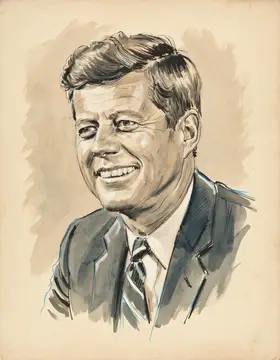
John F. Kennedy on Separation of Church and State
TL;DR
John F. Kennedy asserted his firm belief in the absolute separation of church and state, rejecting religious control over public office.
Key Points
He explicitly stated his support for the constitutional separation of church and state in his September 12, 1960, speech to the Houston Ministerial Association.
He affirmed that he would not permit any ecclesiastical authority, like the Pope, to instruct him on public policy if he were President.
Kennedy indicated that religious liberty is indivisible, meaning an act against one church should be treated as an act against all churches.
Summary
John F. Kennedy, when running for the presidency in 1960, delivered a seminal statement addressing concerns over his Catholic faith regarding the separation of church and state. He declared his belief in an America where this separation is absolute, meaning no religious prelate could direct a President's actions, nor could any minister dictate a parishioner's vote. Furthermore, he stated that no religious body should impose its will, directly or indirectly, upon the general populace or public officials, and no church should receive public funds or political preference.
He maintained this stance when questioned by a Houston Ministerial Association, assuring them that he would not seek guidance from the Pope or any ecclesiastical source on public policy. He specifically affirmed that he would support the constitutional separation, viewing religious liberty as indivisible, and that he would uphold the Constitution if elected. He asserted that his personal religious views were a private affair, neither to be imposed on the nation nor used as a condition for holding office.
Key Quotes
I believe in an America where the separation of church and state is absolute—where no Catholic prelate would tell the President (should he be Catholic) how to act, and no Protestant minister would tell his parishioners for whom to vote—where no church or church school is granted any public funds or political preference—and where no man is denied public office merely because his religion differs from the President who might appoint him or the people who might elect him.
Frequently Asked Questions
John F. Kennedy strongly believed in an America where the separation of church and state was absolute, according to his 1960 Houston speech. He stated that no religious body should impose its will on public officials or the general populace, as detailed in his remarks to the Ministerial Association. He viewed this separation as essential for religious liberty in the United States.
Yes, as the first Catholic to run for president, he publicly addressed concerns about potential religious influence in a major 1960 campaign speech. He assured the audience that his religious views were private and would not dictate his public actions as president. He treated questions on this topic as reasonable given the historical context of anti-Catholic suspicion.
Kennedy told reporters that he believed no public official should accept instructions on public policy from any ecclesiastical source, including the Pope or the National Council of Churches. He also maintained that he would not ask his own church hierarchy to authorize his constitutional views for all Catholics. He saw a necessary division between private faith and public duty.
Sources7
John F. Kennedy on the Separation of Church and State (1960)
Address to the American Society of Newspaper Editors
Transcript: JFK's Speech on His Religion
John F. Kennedy | The First Amendment Encyclopedia
Question and Answer Period Following Speech of Senator John F. Kennedy, Ministerial Association of Greater Houston, Houston, TX
I believe in an America where the separation of church and...
* This is not an exhaustive list of sources.