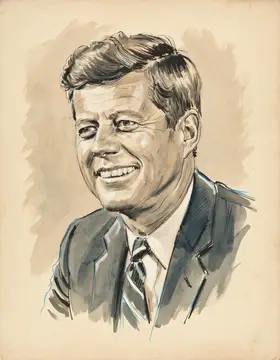
John F. Kennedy on Liberalism
TL;DR
John F. Kennedy strongly embraced the identity of a liberal, framing it as a pragmatic force for progress and necessary change.
Key Points
John F. Kennedy accepted the Liberal Party nomination in New York on September 14, 1960, using the platform to champion progressive causes.
He argued in a 1958 Milwaukee speech that liberalism was about facing challenges and acting for the public good, not about blind adherence to ideology.
Kennedy addressed the New York State Liberal Party on June 23, 1960, advocating for vigorous government action to meet domestic needs.
Summary
John F. Kennedy embraced the identity of a liberal throughout his political career, viewing the philosophy not as a rigid ideology but as a pragmatic vehicle for advancing necessary social and economic progress in the modern era. He frequently used his political speeches, particularly when accepting nominations or addressing party faithful, to redefine and defend liberalism against conservative critiques, insisting that it stood for action, opportunity, and the national interest rather than radicalism. He linked modern liberalism to the forward-thinking traditions of American history, asserting that to be a true liberal was to be committed to the welfare of the nation's citizens and the effective use of government to solve contemporary problems.
His approach to liberalism was characterized by an emphasis on testing policies against real-world results, which sometimes led to nuanced positions that satisfied neither the far-left nor the far-right wings of politics. For Kennedy, this meant advocating for expanded civil rights, support for organized labor, and government investment in education and infrastructure, while simultaneously stressing fiscal responsibility and a strong national defense during the Cold War. This balancing act was a defining feature of his political style, positioning him as a modern, active liberal prepared to govern in complex times.
Frequently Asked Questions
According to his speeches, John F. Kennedy considered the core of liberalism to be a commitment to action and using government pragmatically to meet the challenges facing the nation, as he stated in a 1960 nomination address. He viewed it as the force for progress, not merely an abstract doctrine. He emphasized that his brand of liberalism was dedicated to the welfare of all citizens.
Yes, John F. Kennedy actively courted liberal political organizations, such as addressing the New York State Liberal Party on multiple occasions, according to archival records. He saw these groups as essential allies for advancing his legislative agenda. He often accepted their nominations to demonstrate his alignment with their goals, as seen in September 1960.
John F. Kennedy sought to present his liberalism as a path of necessary, practical governance rather than extreme ideology, told reporters in 1958. He often defined his stance by focusing on the tangible benefits of government action for the public good, differentiating it from what he perceived as stagnation or radicalism in other camps. This approach allowed him to build a broad coalition.
Sources6
Address Accepting His Party's Nomination, New York City
Speech of Senator John F. Kennedy at the Commodore Hotel, New York, NY
Liberal Without a Cause: Understandings of Kennedy's Historic Purpose
The Kennedy Speech That Stoked the Rise of the Christian Right
* This is not an exhaustive list of sources.