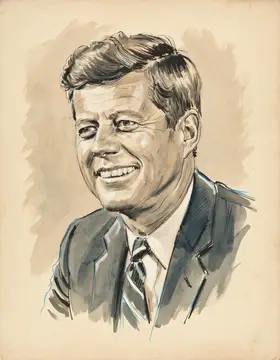
John F. Kennedy on Civil Rights
TL;DR
John F. Kennedy ultimately framed civil rights as a profound moral issue necessitating comprehensive federal legislation and executive action.
Key Points
He initially avoided major civil rights legislation during his first term, fearing loss of crucial Southern Democratic support.
On June 11, 1963, he delivered a televised address framing civil rights as a national moral imperative and proposed the Civil Rights Act of 1963.
His administration used federal intervention, including troops and marshals, to enforce desegregation in public schools and interstate travel when state officials resisted.
Summary
John F. Kennedy initially approached civil rights with political caution, prioritizing his economic and foreign policy agendas by avoiding alienation of Southern Democrats necessary for legislative support. His early administration actions focused primarily on enforcing existing law through executive action, such as dispatching federal marshals to protect Freedom Riders in 1961 and ensuring the integration of James Meredith at the University of Mississippi in 1962. However, escalating racial tensions and the violent national and international focus on incidents like the Birmingham Campaign in 1963 forced a significant evolution in his stance. The horrific images of police dogs and fire hoses against peaceful protesters led him to conclude that a stronger federal commitment was both a political and moral necessity.
Following the confrontation at the University of Alabama, President Kennedy delivered a pivotal televised address on June 11, 1963, where he explicitly defined civil rights as a moral issue as clear as the Constitution, marking a shift from previous legality-focused rhetoric. In that address, he proposed comprehensive civil rights legislation to Congress that aimed to end segregation in public facilities, ensure voting rights, and integrate public schools. Though his proposal faced stalled debate by the time of his assassination in November 1963, this speech and his subsequent actions are recognized as transforming the national discourse and securing his legacy as a champion for civil rights.
Frequently Asked Questions
John F. Kennedy's position evolved from initially cautious support based on legality to strong advocacy for moral rectitude and comprehensive legislation. In his landmark 1963 address, he declared civil rights a core moral issue for the nation.
President Kennedy formally proposed comprehensive civil rights legislation to Congress on June 19, 1963, following his televised national address on the subject on June 11, 1963.
Before his major legislative push, Kennedy utilized executive action by deploying federal marshals to protect activists like the Freedom Riders in 1961. Furthermore, his campaign's intervention to secure the release of Dr. Martin Luther King Jr. from jail in 1960 was critical for gaining Black support.
Sources6
Televised Address to the Nation on Civil Rights
Report to the American People on Civil Rights - Wikipedia
JFK and Civil Rights | American Experience | Official Site | PBS
The Kennedys and the Civil Rights Movement (U.S. National Park ...
Radio and Television Report to the American People on Civil Rights
Civil Rights Act (1964) | National Archives - Archives.gov
* This is not an exhaustive list of sources.