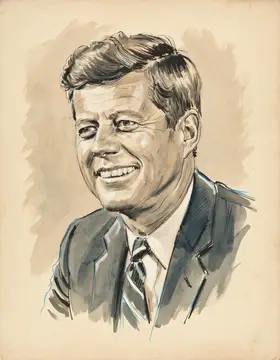
John F. Kennedy on Black People
TL;DR
John F. Kennedy evolved from political caution to publicly championing civil rights as a moral imperative for the nation.
Key Points
He issued Executive Order 10925 in 1961, requiring government contractors to take affirmative action against employment discrimination.
In October 1960, he telephoned Coretta King to express concern for her husband, Martin Luther King Jr., after his arrest, an act credited with swaying Black voters.
In his June 11, 1963, address, he framed the struggle for civil rights as a moral issue facing the entire nation for the first time by a sitting president.
Summary
John F. Kennedy’s position on Black people and civil rights evolved throughout his political career, moving from an initial cautious approach driven by political calculations to a firm stance as president. During his time in Congress, he was largely silent on specific racial issues, though he did support general fairness and non-discrimination in employment, actions often viewed as politically motivated to secure Black votes. A significant shift began during his 1960 presidential campaign, marked by the pivotal phone call to Coretta King and his increased focus on equality, culminating in his administration's more active intervention in escalating Southern conflicts like those in Mississippi and Birmingham.
As president, Kennedy often prioritized avoiding political conflict with powerful Southern Democrats, leading to initial hesitation, such as in the Freedom Rides. However, the intense, publicized confrontations, particularly the violence in Birmingham in May 1963, spurred him to publicly declare the issue a moral crisis in his June 1963 address. This moral framing preceded his proposal of the most sweeping civil rights legislation since Reconstruction, laying the foundation for the 1964 Act, which many historians credit to the momentum he created.
Frequently Asked Questions
Yes, John F. Kennedy's position visibly evolved over time, according to historical accounts. Early in his career, he was politically cautious regarding civil rights legislation, avoiding divisive stances to maintain party unity. By his presidency, intensified national pressure and events like the violence in Birmingham galvanized him to take a stronger, morally-framed stance on the issue.
Many historians point to President Kennedy's televised address on June 11, 1963, where he declared that civil rights was fundamentally a moral issue, not just a legal one. This speech preceded his submission of a comprehensive civil rights bill to Congress, which provided the basis for the eventual 1964 Act.
During the 1960 election, presidential candidate John F. Kennedy called Coretta King to express sympathy after her husband, Martin Luther King Jr., was sentenced to hard labor in Georgia. Subsequently, his brother, Robert Kennedy, contacted the judge, and King was released on bail shortly thereafter, leading King to publicly endorse Kennedy.
Sources7
The Kennedys and Civil Rights | American Experience
JFK & the Civil Rights Movement | Speech, Policies & Quotes
Remarks of Senator John F. Kennedy, Whitewater College ...
June 11, 1963: President Kennedy addressed the nation ...
JFK's civil rights leadership still lights a path for our ...
John F. Kennedy's Legacy Resides in African-American ...
John F. Kennedy and His Role in the Civil Rights Movement
* This is not an exhaustive list of sources.