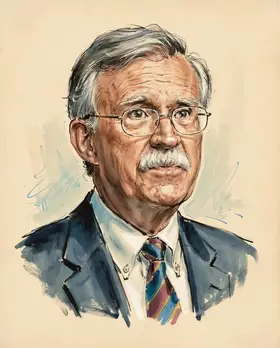
John Bolton on International Law
TL;DR
John Bolton views international law, particularly the ICC, as a direct and dangerous threat to American constitutional sovereignty and national security.
Key Points
He stated the U.S. will use any means necessary to protect citizens from unjust prosecution by the International Criminal Court (ICC) in a September 2018 speech.
Bolton has long argued that international law threatens U.S. constitutional independence and freedom of action, as chronicled in his memoir, Surrender is Not an Option.
His policy approach champions negotiating bilateral agreements to preclude other countries from surrendering U.S. personnel to the ICC, an achievement he cited from his time in the George W. Bush administration.
Summary
John Bolton fundamentally opposes international law and multilateral organizations that he perceives as threatening American sovereignty and freedom of action. He argues that the United States should prioritize its constitutional independence over being constrained by global treaties or supranational bodies lacking democratic provenance. This stance is rooted in the conviction that international law is not true 'law' but merely a set of political or moral obligations that the U.S. can discard when expediency dictates, a view he strongly articulated in speeches opposing the International Criminal Court (ICC).
This perspective frames the US role in the world as needing to guard against an "unholy alliance" of international bureaucrats and anti-American entities determined to subordinate the republic. Bolton's efforts, particularly during his tenure advising the president, focused on repudiating the jurisdiction of bodies like the ICC over U.S. personnel, viewing such international claims as an assault on national sovereignty. This sovereigntist critique champions unilateralism and bilateralism as superior alternatives to formal multilateral cooperation, especially regarding institutions that he believes concentrate unaccountable power.
Key Quotes
We will not cooperate with the ICC. We will provide no assistance to the ICC. We will not join the ICC. We will let the ICC die on its own. After all, for all intents and purposes, the ICC is already dead to us.
When somebody says, “That's the law,” our inclination is to abide by that law. Thus, if “international law” is justifiably deemed “law,” Americans will act accordingly. On the other hand, if it is not law, it is important to understand that our flexibility and our policy options are not as limited as some would have us believe.
Frequently Asked Questions
John Bolton views international law primarily as a challenge to American sovereignty, not as binding or legitimate law when it supersedes national consent. He believes engagement with supranational bodies is often self-defeating and constrains necessary U.S. freedom of action in global affairs.
He delivered a major announcement in September 2018 that the U.S. would not cooperate with, assist, or join the ICC, labeling it illegitimate. Bolton threatened sanctions and prosecution against ICC judges and prosecutors if they investigated Americans concerning Afghanistan.
His core position against the supranational authority of international bodies and in favor of national sovereignty has been consistent across various roles. Critics have noted this stance, characterized as 'sovereigntist,' dates back to his time as UN Ambassador and before.
Sources9
Bolton Is Right to Repudiate International Criminal Court's Jurisdiction Over U.S. Military, Government Officials
Full text of John Bolton's speech to the Federalist Society | ICC News
John Bolton, Sovereignty Warrior
The Trump Administration and the International Criminal Court: A Misguided New Policy
The ICC Is Dead to John Bolton, But Not the Public
Trump Administration Threatens International Criminal Court Judges and Prosecutors for Doing Their Jobs
International Law and the American National Interest
The Limits Of The Limits Of International Law
"International Law and the American National Interest" by Michael Byers
* This is not an exhaustive list of sources.