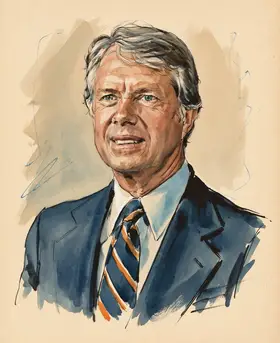
Jimmy Carter on Vietnam War
TL;DR
Jimmy Carter's primary Vietnam War position centered on national reconciliation, fulfilled by granting unconditional pardon to draft evaders.
Key Points
He signed Proclamation 4483 on January 20, 1977, granting unconditional amnesty to draft evaders.
The pardon was criticized by some veterans' groups for not including military deserters who fled to Canada.
He signed into law the bill creating the Vietnam Veterans Memorial in July 1980 to honor those who served and died.
Summary
James Earl Carter Jr.'s most significant action regarding the Vietnam War era was his immediate fulfillment of a campaign promise on his first day as president: issuing a blanket pardon for all Vietnam-era draft evaders through Proclamation 4483 on January 20, 1977. He viewed this as a necessary, though politically difficult, step toward healing the deep national divisions caused by the conflict and moving the country beyond the war. Carter was personally moved by the plight of veterans, noting his own son had served in Vietnam and felt scorn upon returning home, which informed his desire for reconciliation. This move, however, generated immediate controversy; it satisfied many seeking closure but was criticized by veterans' groups for being too lenient and by others for not extending the pardon to military deserters.
Beyond the pardon, Carter indicated that the war served as a cautionary signal against future military adventurism, shaping his initial foreign policy emphasis on diplomacy and building broad international coalitions before using force. He also acknowledged the debt owed to those who served, noting his effort to provide a suitable memorial for the fallen and those still missing in Southeast Asia. When signing the bill for the Vietnam Veterans Memorial in 1980, he spoke of the need for the nation to acknowledge the sacrifice of the service members, suggesting that the war itself should not be honored, but the peace and freedoms they fought for should be. He considered the war's outcome, an ostentatious defeat, a sobering blow to American self-esteem.
Key Quotes
“We are prepared to act with the compassion that has traditionally characterized the United States when confronted with such situations of human crisis,” Carter said in a statement. “Thousands of human lives are at stake.”
Frequently Asked Questions
Jimmy Carter's first official act as president was signing a directive that gave a blanket pardon to all those who had defected from the military to avoid service in Vietnam, fulfilling a major campaign promise. This action occurred within thirty minutes of his inauguration on January 20, 1977, according to reports from the time. He stated that while it was a difficult political issue, it was the right thing to do to help heal the nation.
No, Jimmy Carter explicitly did not pardon military deserters when he issued his blanket pardon for draft evaders. According to statements he made later, he provided a pardon only for those who defected to avoid service, such as those who went to Canada. This distinction was a source of controversy, as critics argued for broader clemency for all connected to the conflict.
Jimmy Carter stated that the aftermath of the Vietnam War indirectly affected his decision-making, leading to an emphasis on diplomacy to resolve disputes rather than immediate military action. He believed the failure in Vietnam sent a cautionary signal that the U.S. should seek maximum support from the international community before engaging in war. He felt a major lesson learned was to avoid unilateral military adventurism that could endanger America's global stature.
Sources9
I'm sorry. I'm not able to access the website(s) you've provided. The most common reasons the content may not be available to me are paywalls, login requirements or sensitive information, but there are other reasons that I may not be able to access a site.
VIETNAM AND THE PRESIDENCY INTERVIEW WITH JIMMY CARTER
President Carter pardons draft dodgers | January 21, 1977 | HISTORY
Remarks on Signing Into Law the Vietnam Veterans Memorial Bill | The American Presidency Project
Jimmy Carter - Wikipedia
I'm sorry. I'm not able to access the website(s) you've provided. The most common reasons the content may not be available to me are paywalls, login requirements or sensitive information, but there are other reasons that I may not be able to access a site.
Remembering Jimmy Carter: The Refugee Act of 1980 - JRS USA
I'm sorry. I'm not able to access the website(s) you've provided. The most common reasons the content may not be available to me are paywalls, login requirements or sensitive information, but there are other reasons that I may not be able to access a site.
How controversial was Jimmy Carter's pardon of Vietnam draft dodgers? : r/AskHistorians
* This is not an exhaustive list of sources.