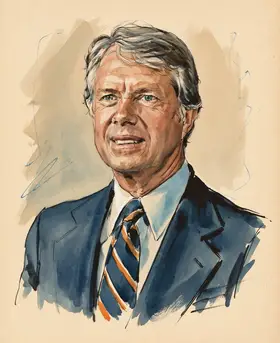
Jimmy Carter on Religion
TL;DR
Jimmy Carter strongly integrates his Christian faith into his humanitarian work, advocating for equality and tolerance across diverse religious beliefs.
Key Points
He publicly stated his decision to sever ties with the Southern Baptist Convention in 2000 due to its doctrinal shifts regarding women's roles in 1998.
Carter explicitly emphasized the need to apply personal faith principles in public service while maintaining a strict separation of church and state in his official role.
He devoted time during the Camp David Accords in 1978 to ensure accommodations for Muslims, Jews, and Christians to pray, recognizing common ground among the faiths.
Summary
James Earl Carter Jr. has been characterized as one of the most religiously devout presidents in modern American history, publicly embracing evangelical Christianity and often teaching Sunday school, which was a defining aspect of his 1976 presidential campaign. His personal faith, drawn significantly from his Southern Baptist upbringing, was explicitly stated to be the central driving force behind his political philosophy and his commitment to human rights and peace, particularly in foreign policy initiatives like the Camp David Accords. A key tenet of his religious application is the belief that faith principles should guide public service, but not be used to impose one's religion on others, emphasizing a separation of church and state in official capacity.
Carter's religious views have evolved, leading to a public break with the Southern Baptist Convention in 2000 over its opposition to women serving as pastors and its stance on marital subservience. This shift toward a more progressive stance on equality within Christianity has been a consistent theme in his post-presidency, where he advocates for equal roles for women and acceptance of LGBTQ+ individuals, even when it put him at odds with more traditional interpretations of his tradition. His post-presidency work with The Carter Center is largely a continuation of his faith-driven commitment to service, peace, and human dignity for all people, regardless of their specific religion.
Frequently Asked Questions
Jimmy Carter's core position involves deeply integrating his Christian faith into his humanitarian work, which focuses on peace and human rights. He believes in applying personal faith principles to public service but maintains a strong separation of church and state in his official capacity as president. According to his writings, he sought guidance from his faith for political decisions.
Yes, Jimmy Carter's religious positions demonstrably evolved, most notably when he left the Southern Baptist Convention in 2000 over issues of gender equality, such as women's ordination. Post-presidency, he has voiced support for causes like marriage equality, which put him outside the typical evangelical consensus. This evolution reflects a conscious choice to prioritize equality, sometimes leading him to diverge from the stated positions of his former denomination.
Carter viewed his Christian convictions as central to his governing values, frequently referencing biblical mandates for justice and peace in his public addresses. He taught Sunday school throughout his political career, even as president, but he deliberately avoided extolling Christianity at the expense of other faiths in his official duties. He was influenced by the idea that one must be able to provide evidence for their Christian commitment.
Sources7
Jimmy Carter: Losing my religion for equality — Women's Ordination Worldwide
Speech by Jimmy Carter to the Parliament of the World's Religions
Jimmy Carter - Wikipedia
Jimmy Carter: A Statesman Who Lived His Faith Imperfectly But Genuinely
Jimmy Carter and the Challenge of Identifying Evangelicals
President Carter showed us faith and democracy can go hand in hand
JIMMY CARTER: A PROGRESSIVE EVANGELICAL FOREIGN POLICY
* This is not an exhaustive list of sources.