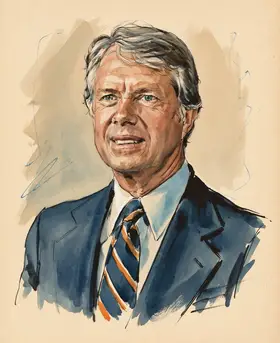
Jimmy Carter
- Known for
- 39th U.S. President, Post-presidency humanitarian work, Peanut farmer
- Born in
- Plains, Georgia
- Education
- Bachelor of Science, Union College
Jimmy Carter, the 39th U.S. President, defined his career by a deep commitment to evangelical Christianity and a focus on human rights and global peace. His presidential tenure (1977–1981) was marked by economic turbulence, while his subsequent post-presidency has garnered near-universal acclaim.
Signature Positions
Carter's administration delivered key foreign policy achievements alongside domestic reorganization:
- Middle East: Brokered the historic Camp David Accords, leading to peace between Israel and Egypt.
- Foreign Policy: Established diplomatic relations with the People's Republic of China (PRC) while navigating the Iran Hostage Crisis.
- Domestic Policy: Created the cabinet-level Department of Education and signed landmark environmental legislation like the Surface Mining Control and Reclamation Act.
- Energy: Framed the U.S. energy crisis as the "moral equivalent of war," emphasizing conservation and establishing the Department of Energy.
- Vietnam War: Issued unconditional amnesty for Vietnam War-era draft evaders early in his presidency.
How Views Have Evolved
Carter’s public stances underwent notable shifts, especially regarding race and civil rights:
- Racism/Civil Rights: As Georgia governor, he ran a campaign appealing to segregationist sentiments, but immediately pivoted upon taking office, declaring, "the time for racial discrimination is over."
- Nuclear Energy: Following a harrowing experience with a partial meltdown at Chalk River, Carter shifted from involvement in the nuclear program to advocating for limitations, influencing his views on the neutron bomb.
Notable Tensions
Carter's presidency was defined by significant domestic friction:
- Relations with Congress: He frequently clashed with Congress, avoiding favors and insulting members, which hampered his ability to pass legislation, especially his energy proposals.
- Economic Stagnation: His final years were overwhelmed by stagflation, characterized by high inflation and slow economic growth, contributing to his 1980 defeat.
- International Alliances: Despite a stated human rights focus, his administration continued military support for regimes like Suharto in Indonesia.
While his presidency is historically ranked as below average, his prolific post-presidency earned him the 2002 Nobel Peace Prize. He became a global symbol of humanitarianism through the Carter Center, working on disease eradication and election monitoring, ultimately living longer than any other U.S. President.