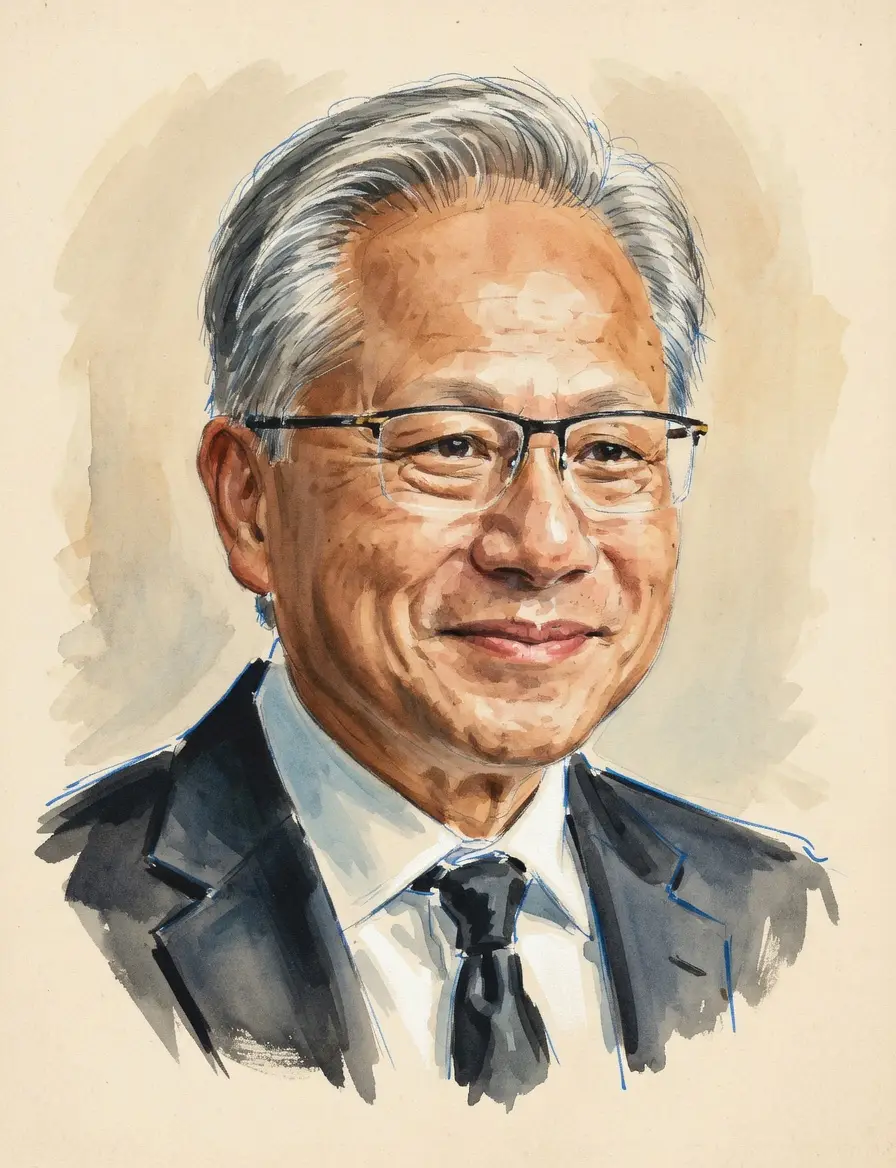
Jensen Huang on Physical AI
TL;DR
Jensen Huang declares that the breakthroughs in Physical AI mark the revolutionary 'ChatGPT moment' for robotics and intelligent machines.
Key Points
He explicitly stated that the "ChatGPT moment for robotics is here" as of January 2026 at the CES conference.
NVIDIA is developing open physical AI models, including Cosmos Predict and GR00T, to lower the barrier to entry for building generalist-specialist robots.
He advocates for a three-computer system—training, edge deployment, and a digital twin (Omniverse/Cosmos)—to solve the 'three-body problem' of physical AI development.
Summary
Jensen Huang asserts that the current breakthroughs in Physical AI signify the long-awaited "ChatGPT moment" for the field of robotics, unlocking entirely new applications. He frames this as a massive industrial era driven by models that can comprehend the real world, reason, and formulate actions, fundamentally changing machines from single-task tools to reasoning generalist-specialist robots. The company's strategy is centered on providing a full technology stack, including Jetson robotics processors, Omniverse simulation, and new open physical AI models like Cosmos and GR00T, to empower a global ecosystem of partners to deploy AI-driven robots across every industry.
He posits that every robotics entity will ultimately require a three-computer solution to manage the complexities of training, deployment, and refinement for autonomous mobility systems. This solution involves one computer for training, one for edge inferencing on the physical device, and a digital twin built using platforms like Omniverse and the Cosmos world foundation model to bridge the two and generate synthetic data for continuous learning. This systematic approach, which aims to give machines intuition derived from massive data processing, is set to accelerate the transition from research to real-world use cases, with a significant focus on industrial applications like automotive and manufacturing.
Key Quotes
"The ChatGPT moment for robotics is here."
Frequently Asked Questions
Jensen Huang is a strong advocate for Physical AI, viewing its current breakthroughs as a landmark event comparable to the arrival of ChatGPT for generative AI. He sees it as the key to unlocking a new era of intelligent, reasoning robots across all industries. His company, NVIDIA, is positioning itself as the foundational technology provider for this shift.
He believes that breakthroughs in Physical AI models are enabling machines to understand the real world, reason, and plan actions, which is unlocking entirely new applications. Jensen Huang has stated that this technology will transform industries by turning difficult-to-program machines into adaptable generalist-specialist robots. He also suggests these robots could serve as 'AI immigrants' to address labor shortages.
NVIDIA's strategy revolves around providing a complete, full-stack approach that encompasses specialized hardware like Jetson processors, simulation platforms like Omniverse, and open foundation models for robot learning and reasoning. Jensen Huang emphasizes the need for partners to leverage this stack to accelerate the development lifecycle for AI-driven robotics.
Sources6
NVIDIA Releases New Physical AI Models as Global Partners Unveil Next-Generation Robots
Jensen Huang Says the "ChatGPT Moment" for Physical AI Has Arrived. Here Are 2 Stocks to Buy for 2026.
NVIDIA CEO Jensen Huang and Global Technology Leaders to Showcase Age of AI at GTC 2026
Davos 2026: Nvidia CEO Jensen Huang on how AI is becoming the next great infrastructure build
NVIDIA takes on physical AI for automotive, industrial and robotics
Jensen Huang explains that NVIDIA is embedding physical AI and agentic AI directly into industrial software and factory systems. : r/accelerate
* This is not an exhaustive list of sources.