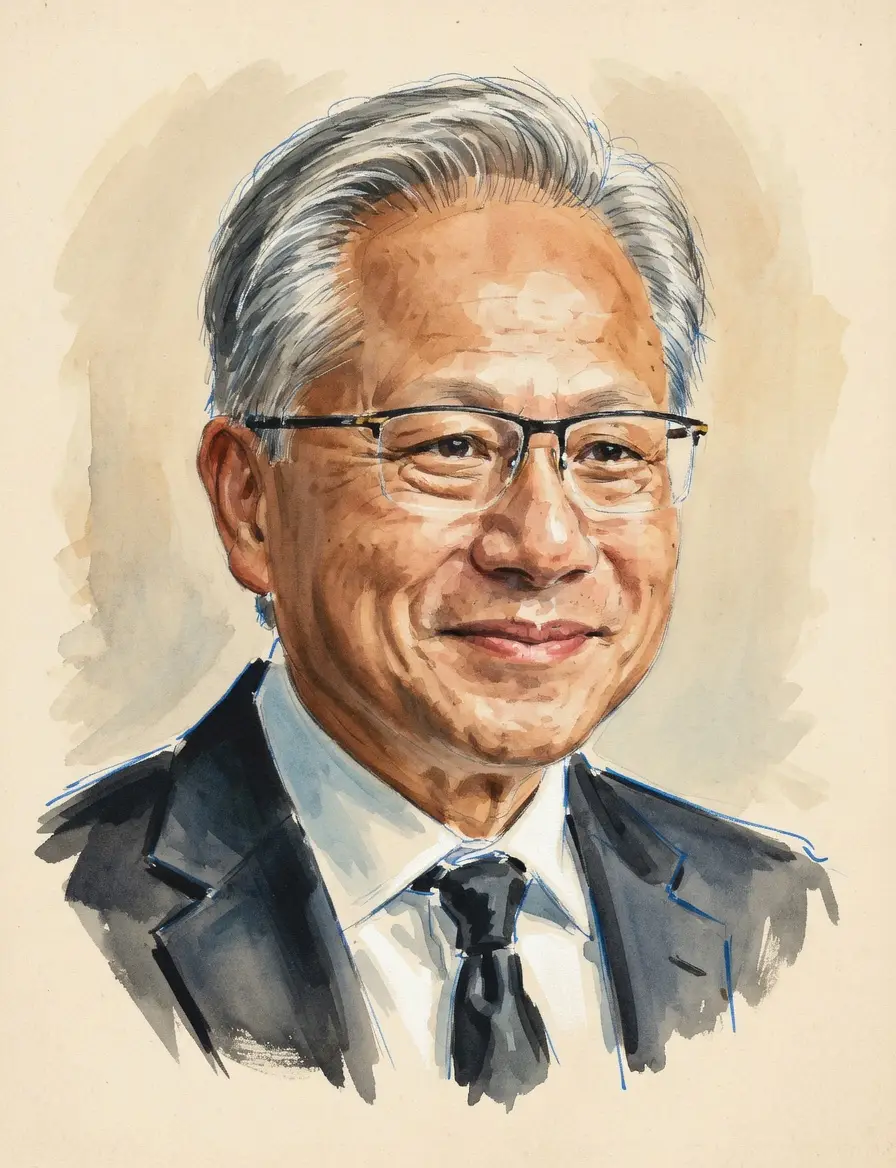
Jensen Huang on Entrepreneurship
TL;DR
Jensen Huang views entrepreneurship as a persistent journey of solving important problems using first-principles thinking, even through severe adversity.
Key Points
He advocates that entrepreneurial survival hinges on a core belief coupled with a willingness to learn from mistakes and pivot to industry standards when necessary, as seen after the NV1 failure.
Huang stresses using first-principles thinking to reinvent processes and decisions based on current conditions, rather than accepting the status quo simply because a competitor does it.
A key aspect of his leadership philosophy is structuring an organization to be highly flat and transparent, empowering employees to make critical decisions by giving them context and information.
He advises that a worthy entrepreneurial pursuit is one that advances a field of science or solves a problem that would not be addressed if the company did not step in.
Summary
Jensen Huang, the co-founder and CEO of NVIDIA, articulates a perspective on entrepreneurship heavily weighted toward long-term vision, resilience, and fundamental reasoning. His own founding story involved bootstrapping the company based on the belief that a new type of computer—the GPU—could solve problems general-purpose computing could not, initially focusing on 3D gaming. This initial vision failed with the NV1 chip, leading to near bankruptcy, which he cites as a critical learning moment reinforcing the need to align technology with existing market needs, as exemplified by pivoting to the Direct3D standard. He believes entrepreneurs must stay grounded in their core beliefs while remaining adaptable to evidence that their initial assumptions might be flawed.
He champions the use of first-principles thinking to constantly re-evaluate a company's direction given changing conditions, rather than merely iterating on past success or succumbing to external pressures like stock price volatility. Huang emphasizes that true entrepreneurial contribution comes from tackling problems others cannot or will not, finding inspiration in the importance of the work rather than just market size. For him, the organization itself must be architected from first principles—a flat structure designed to empower highly informed employees to question assumptions and pursue those uniquely impactful projects, which ultimately creates the conditions for their life's work.
Frequently Asked Questions
Jensen Huang has suggested that if he had to start NVIDIA over again under current conditions, he might not do it, noting that nobody in their right mind would undertake such a massive challenge voluntarily. This sentiment highlights the extreme difficulty and risk inherent in founding a groundbreaking technology company.
His core advice revolves around maintaining a firm core belief, gut-checking it daily, and pursuing it with intense effort for a very long time, all while being surrounded by people one trusts to take the journey with. He strongly recommends using first-principles thinking to re-evaluate strategy based on new conditions.
He views significant early setbacks, such as the failure of NVIDIA's first product, not as reasons to quit, but as crucial learning experiences that necessitate a strategic reset. For him, the lesson from failure is to embrace what the market needs, even if it means abandoning an initial, proprietary vision.
Sources5
Nvidia Founder Admits: 'Wouldn't Start Company If I Had To ...
Jensen Huang on How to Use First-Principles Thinking to Drive Decisions
Read This From Nvidia's CEO If Considering Starting Company - Business Insider
Note on a Manager-Entrepreneur I Admire: Jen-hsun “Jensen” Huang
Jensen Huang: Entrepreneurial Insights | PDF | Entrepreneurship | Artificial Intelligence
* This is not an exhaustive list of sources.