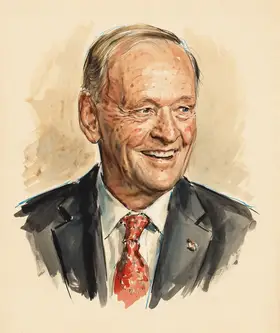
Jean Chrétien on Canada
TL;DR
Jean Chrétien has consistently been a strong federalist who worked to maintain the unity and independence of Canada against internal and external pressures.
Key Points
He played a significant role in the patriation of the Constitution of Canada and the establishment of the Canadian Charter of Rights and Freedoms in 1982.
He strongly opposed the Quebec sovereignty movement, leading the federalist campaign to a narrow victory in the 1995 Quebec referendum.
He pioneered the Clarity Act, which passed in 2000, to set the conditions for any future referendum on secession.
Summary
Jean Chrétien, throughout his political career, positioned himself as a staunch advocate for a strong, united Canada, most notably evidenced by his role in defeating the Quebec sovereignty movement. He led the federalist campaign to a narrow victory in the 1995 Quebec referendum, and following that near-defeat, he pioneered the Clarity Act, which sought to establish clear federal conditions for any future secession vote. This commitment to national unity was a core, defining element of his tenure, setting him apart from sovereigntists within his home province.
His views on Canada also involved asserting national independence, particularly in foreign and economic policy vis-à-vis the United States. He actively worked to avoid the perception of Canada being the "51st state" by maintaining a diplomatic distance from U.S. presidents when policy alignment was weak, such as regarding the Iraq War. Furthermore, he pursued trade diversification, aiming to lessen economic dependence on the U.S., while simultaneously emphasizing that the two nations shared a vital cross-border economic relationship.
Frequently Asked Questions
Jean Chrétien's core position has always been one of strong federalism and national unity. He famously led the 'No' campaign in the 1995 Quebec referendum, viewing separation as a threat that needed to be aggressively fought. According to his actions, he believed in a strong federal government protecting the nation's structure.
His approach to the U.S. was guided by a consistent policy of asserting Canadian independence, even while maintaining a close bilateral relationship, as detailed in oral histories from 2009. He stated that he did not want to look like the "51st state of America," leading him to make policy decisions like refusing to join the Iraq War.
In a recent discussion with a former political rival, Jean Chrétien stated that tensions with the U.S. have spurred Canadian pride, making Canadians proud of their identity. He praised Canada's values, including education and tolerance, in a February 2026 event.
Sources7
Jean Chrétien: Canadians will never give up the best ...
Stephen Harper, Jean Chretien on Canada, U.S. threats
Jean Chrétien
Former Canadian Prime Minister Jean Chrétien warns 'the ...
Canadians will never give up the best country in the world ...
Jean Chrétien Oral History
Remarks Following Discussions With Prime Minister Jean ...
* This is not an exhaustive list of sources.