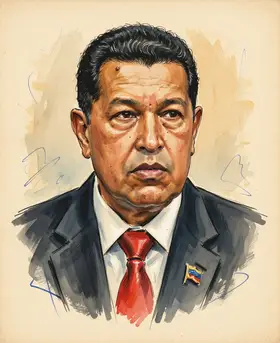
Hugo Chávez on America
TL;DR
Hugo Chávez vehemently opposed what he termed US imperialism, seeing America as a hegemonic threat to regional sovereignty and socialist goals.
Key Points
He repeatedly accused the US government of supporting domestic opposition efforts to remove him from office, citing the brief 2002 coup as evidence of this intent.
He countered US-led initiatives like the Free Trade Area of the Americas (FTAA) by promoting regional blocs such as the Bolivarian Alliance for the Peoples of Our America (ALBA).
In a September 2006 speech to the UN, Hugo Chávez characterized the hegemonic claims of North American imperialism as the greatest threat hanging over the planet.
Summary
Hugo Chávez positioned himself as an implacable opponent of United States foreign policy, consistently characterizing the US as an imperialist power intent on undermining Venezuela’s sovereignty and its project of twenty-first-century socialism. He frequently accused Washington of seeking to dominate Latin America, or Nuestra América, referencing historical US interference, including the memory of the 2002 coup attempt which his administration claimed was planned and participated in by the US government. This adversarial stance fueled his commitment to fostering regional unity through organizations like ALBA and CELAC, designed specifically as counterweights to US influence, such as the former Free Trade Area of the Americas (FTAA).
His rhetoric framed the relationship as an unavoidable conflict, frequently employing sharp personal attacks against US presidents and describing US policies as a threat to global peace and the environment. In response to perceived aggression, Chávez pursued diversification of international relations, including strengthening ties with Cuba, Iran, Russia, and China, and actively worked to promote a multipolar world order to balance American hegemony. Despite the antagonism, a significant commercial relationship persisted, as Venezuela remained a major oil supplier to the US throughout much of his tenure, which complicated the purely confrontational nature of their diplomatic ties.
Frequently Asked Questions
Hugo Chávez held a strongly negative position on the United States, viewing it primarily as a hegemonic and imperialist power. He frequently accused Washington of intervening in Latin American affairs to protect its own economic and political interests, according to analyses of his rhetoric and policies.
Despite the intense antagonism and sharp rhetoric, a key commercial relationship persisted, as Venezuela was a major supplier of imported oil to the United States. This economic interdependence somewhat tempered the diplomatic confrontation throughout his presidency.
Chávez actively worked to build regional counterweights to US power, founding integration blocs like CELAC and ALBA, which explicitly excluded the US and Canada. He also publicly condemned US military actions abroad, such as the invasion of Afghanistan and the intervention in Libya, as acts of aggression.
Sources7
The Strategic Revolutionary Thought and Legacy of Hugo Chávez Ten Years After His Death
How The Us Lost Latin America To Hugo Chavez - Logos Journal
Hugo Chávez - Wikipedia
The US War on Venezuela began in 2001 : Peoples Dispatch
In Search of Hugo Chávez
Venezuelan President Hugo Chavez's Speech to the UN
The Growing Tension Between Venezuela and the United States
* This is not an exhaustive list of sources.