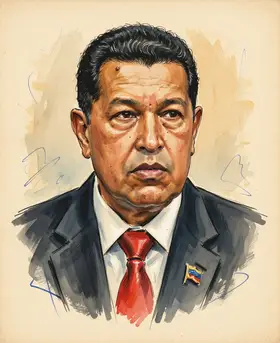
Hugo Chávez on Maduro
TL;DR
Hugo Chávez's political project was designed for Nicolás Maduro to inherit and continue the Bolivarian Revolution's path.
Key Points
Chávez selected Maduro as his vice president and hand-picked successor before his death in 2013.
Maduro was sent by Chávez to meet the author in 2004 to review evidence regarding assassination plots.
The military elite, politicized and enriched under Chávez, became the principal pillar of support for Maduro.
Summary
Hugo Chávez designated Nicolás Maduro as his chosen successor, indicating that Maduro was the intended individual to carry forward the Bolivarian Revolution after Chávez's death in 2013. The continuity of the political project is evident as Maduro vowed to continue the policies and ideology established by his predecessor. Furthermore, structural changes made under Chávez, such as politicizing the armed forces, created a principal pillar of support that remained loyal to Maduro. While some analyses suggest Maduro is simply managing the aftermath of Chávez's policies, others note that Maduro's tenure has seen the model evolve into a more explicit dictatorship.
Chávez prepared the institutional ground for an authoritarian continuation, even implementing a technical system for vote-counting that his successor, Maduro, could utilize for maximum legitimizing effect when he won, or simply ignore when he lost. Despite Maduro's unpopularity and subsequent electoral challenges, the foundational structure and political base established by Chávez ensured his position. The fact that the regime's economic model, initiated by Chávez and continued by Maduro, led to catastrophic economic collapse is a common point noted by observers, even those who recall Chávez fondly.
Frequently Asked Questions
Hugo Chávez explicitly designated Nicolás Maduro as his hand-picked successor to continue the Bolivarian Revolution. This designation was a key moment, indicating Chávez's belief that Maduro was the appropriate individual to govern after his death, according to analysis of the period. Chávez had elevated Maduro to Vice President shortly before his own health declined.
While Chávez died before the worst of the economic collapse, his policies—such as mismanagement of the state oil company and extensive nationalizations—created the foundation for the crisis. Observers note that the economic model he promoted ultimately led to the ruin Venezuela experienced under Maduro's rule. Thus, the disaster is frequently seen as the legacy of Chávez's entire project, not solely Maduro's actions.
The relationship is viewed as one of direct political succession, with Maduro being the continuation of Chávez's Chavismo ideology and government structure. While some suggest Maduro is merely juggling the aftermath of Chávez's mismanagement, the consensus is that Maduro consolidated the authoritarianism Chávez had been building. The military support Maduro retains is a direct structural legacy from Chávez's later years.
Sources6
How Maduro and Chavez wrecked Venezuela's economy
Venezuela, 20 years after Chavez
How Maduro Stole Venezuela's Vote
Before Nicolás Maduro, There Was Hugo Chávez | FRONTLINE | PBS | Official Site | Documentary Series
I met Chávez and Maduro. I know drugs are not the reason Trump wants war with Venezuela
How is Hugo Chávez seen today in Venezuela and the wider region? And did Maduro's disastrous rule taint his image? : r/asklatinamerica
* This is not an exhaustive list of sources.