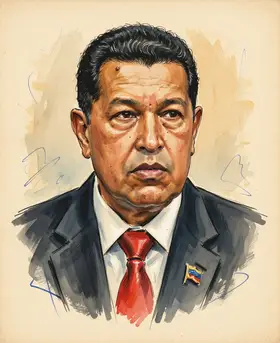
Hugo Chávez
- Known for
- Venezuelan presidency, Bolivarian Revolution, Pink Tide leadership
- Born in
- Sabaneta, Venezuela
- Education
- Venezuelan Academy of Military Sciences
Hugo Chávez was the revolutionary military officer who steered Venezuela into the 21st century as its President from 1999 until his death in 2013. His leadership was defined by the Bolivarian Revolution, a radical socialist project deeply rooted in Bolivarianism and ardent anti-imperialism.
His governance relied heavily on vast oil wealth to fund ambitious social programs, leading to both celebrated temporary reductions in poverty and significant long-term economic instability.
Signature Positions
Chávez's tenure was marked by sweeping domestic and international transformations:
- Economic Policy: Implemented populist Bolivarian Missions fueled by nationalized oil revenue, simultaneously imposing strict currency controls and price ceilings.
- Political System: Dismantled previous governmental checks and balances, adopting the 1999 Constitution which centralized power and extended presidential terms.
- Foreign Policy: Adopted an explicitly anti-imperialist stance, strongly opposing America's foreign policy and forging strategic alliances with Cuba and Iran.
- Ideology: Publicly aligned with Marxism and promoted Socialism of the 21st century, rejecting neoliberal capitalism.
Notable Tensions
Chávez's rule generated intense domestic and international controversy:
- Democratic Backsliding: Critics point to the suppression of the press, manipulation of electoral laws, and increasing authoritarianism, despite Chávez winning 13 out of 14 national votes.
- Economic Unsustainability: While social inequality (Gini coefficient) dropped significantly, reliance on oil led to eventual collapse; price controls triggered severe shortages of basic goods.
- Crime and Corruption: The presidency saw sharp increases in the murder rate and widespread government corruption, with Chávez failing to meet early anti-corruption goals.
- International Relations: His close ties with Israel's adversaries and alleged material support for groups like the FARC strained regional and global diplomacy.
Chávez fundamentally reshaped Venezuelan politics, creating the ideology of Chavismo which formed the core of the Latin American “pink tide.”
His political style blended populist military strongman tactics with socialist rhetoric inspired by figures like Fidel Castro and Simón Bolívar.
Despite domestic turmoil and economic collapse toward the end of his life, his electoral legitimacy remained largely intact until his death in 2013.